
The UK’s immigration framework is currently undergoing its most significant transformation in a generation. For businesses and families in Glasgow, staying ahead of these shifts is no longer optional; it is a prerequisite for security and growth. As of January 2026, the Home Office has implemented rigorous new standards for language proficiency, salary thresholds, and corporate compliance.
At JRI, we recognise that behind every application is a business objective or a family’s future. Our expert lawyers and solicitors in Glasgow provide the technical precision and inclusive care needed to turn these regulatory hurdles into successful outcomes. Whether you are a corporate sponsor or an individual seeking settlement, JRI offers the clarity and confidence to master the 2026 rules.
The New Standard for Business: Sponsorship and Compliance in 2026
For the Scottish business community, the “high-enforcement” era has arrived. The Home Office has significantly intensified its scrutiny of Sponsor Licence holders, utilising real-time data-sharing with HMRC to monitor salary levels, working hours, and tax contributions. In 2026, the privilege of sponsorship comes with an absolute requirement for procedural excellence.
The £60,000 Risk: Protecting Your Business from Civil Penalties
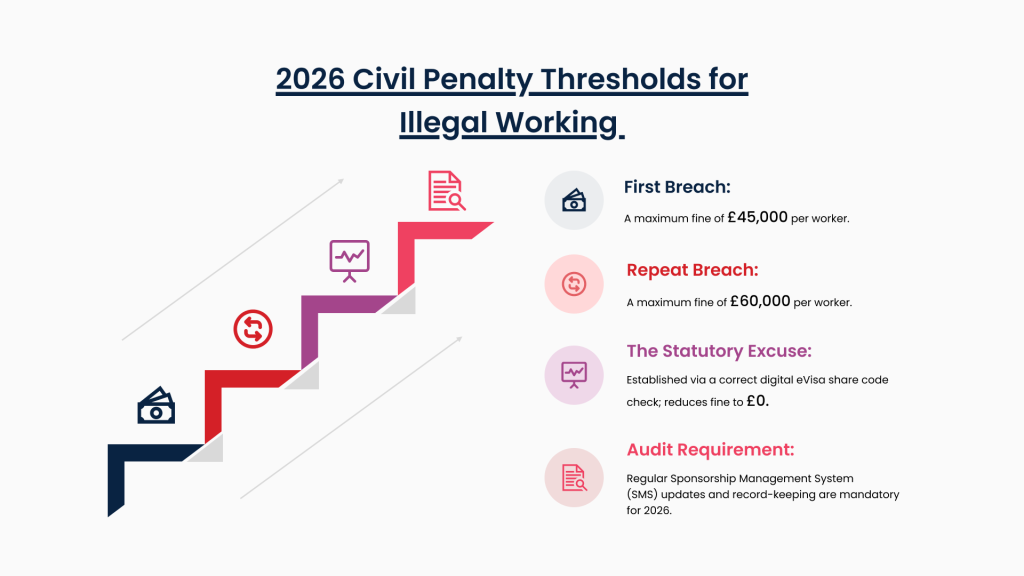
The financial stakes for illegal working have reached record highs. Since the major legislative pivot that concluded in early 2026, the penalties have been set at a level designed to be prohibitive. As of 13 February 2026, a first breach attracts a civil penalty of £45,000 per worker, while repeat offences incur a swingeing £60,000 levy.
This penalty applies even to inadvertent oversights in Right to Work checks. JRI helps you implement robust HR protocols, ensuring you maintain a Statutory Excuse through correct digital checks and record-keeping. Our solicitors conduct forensic “mock audits” that mirror Home Office inspections, identifying vulnerabilities in your Sponsorship Management System (SMS) before they trigger a formal investigation.
Mastering the Skilled Worker Visa Pivot
The Skilled Worker route remains the backbone of Glasgow’s recruitment of international talent. However, as of 8 January 2026, the entry requirements have reached a new peak of complexity.
The B2 Language Mandate
The most impactful update is the elevation of the English language requirement. All first-time Skilled Worker applicants must now demonstrate proficiency at CEFR Level B2 (Upper-Intermediate). This replaces the previous B1 standard and is roughly equivalent to an A-Level or Higher exam in Scotland. Candidates must pass a Secure English Language Test (SELT) in speaking, reading, writing, and listening at this higher level.
2026 Salary Thresholds
The general minimum salary threshold is now firmly set at £41,700 for most new applicants. Furthermore, the “going rates” for specific SOC 2020 occupation codes have been uprated. Failing to meet even a single penny of these thresholds results in an immediate refusal.
The Digital eVisa Transition
Physical Biometric Residence Permits (BRPs) are now obsolete. All workers hold a digital eVisa. Employers must obtain a Share Code from the worker and perform an online check via the official portal. Retaining a dated screenshot of this digital check is the only way to secure a statutory excuse against the £60,000 fines.
2026 Skilled Worker Benchmarks:
| Requirement | 2025 Standard | 2026 Update (Effective 8 Jan) |
| English Language | CEFR Level B1 (Intermediate) | CEFR Level B2 (Upper-Intermediate) |
| Min. Salary (New) | £38,700 | £41,700 |
| Evidence Type | BRP / Physical Card | Digital eVisa / Share Code |
Secure Your Commercial Future in Glasgow
Does your business meet the new B2 English and £41,700 salary mandates? A single error in a Certificate of Sponsorship (CoS) can lead to licence revocation and a 10-year ban. Contact JRI’s corporate immigration specialists today for a comprehensive compliance audit.
Securing Your Future: Family Visas and the Path to Settlement
For families in Glasgow, the 2026 landscape requires careful financial and temporal planning. While the government continues to review certain thresholds, the shift toward “Earned Settlement” is the primary focus for our individual clients.
The Financial Requirement for Partners and Spouses
The Minimum Income Requirement (MIR) for sponsoring a foreign partner remains at £29,000 as of early 2026. This threshold applies whether or not dependent children are included in the application. At JRI, we specialise in complex financial mapping. We help you navigate the strict rules of Appendix FM, ensuring your combined household income—whether employment, self-employment, dividends, or cash savings meets the Home Office’s stringent evidentiary standards.
If you initially applied before April 2024, you may still benefit from transitional arrangements at the £18,600 level. Our solicitors audit your previous filings to ensure you utilise the most favourable threshold available to you.
Navigating the 2026 “Earned Settlement” Transition
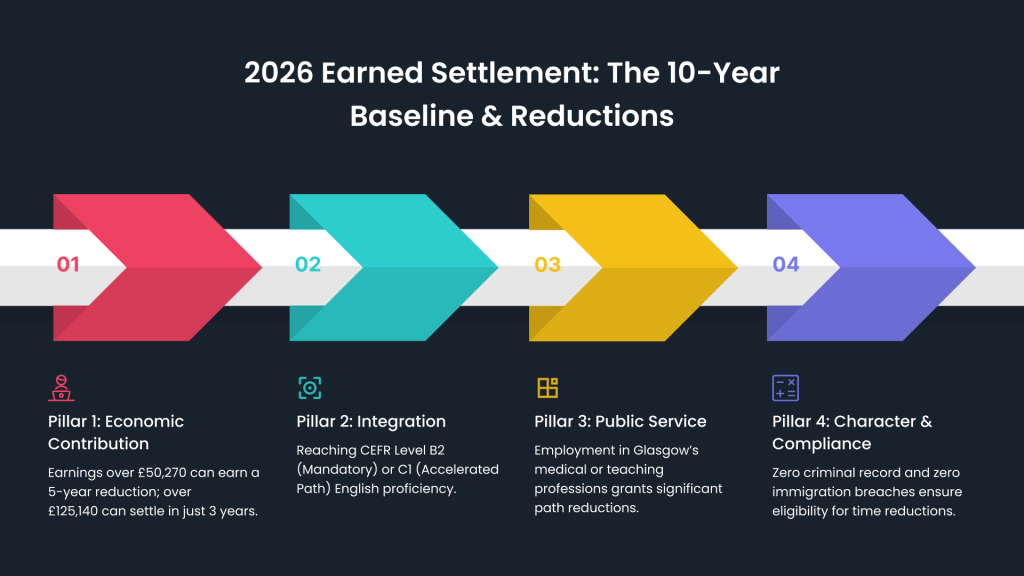
The most significant change currently being implemented is the move toward an “Earned Settlement” model. The baseline residence period for Indefinite Leave to Remain (ILR) for many migrants is increasing to 10 years from the previous five years. However, this system operates on a “Time Adjustment” model, meaning your path can be shortened or lengthened based on your contribution to Scotland.
Under the Earned Settlement system, your path is influenced by four core pillars:
- Economic Contribution: Higher earners (e.g., those with a taxable income over £50,270) may earn a 5-year reduction, allowing settlement in as little as five years. Those earning over £125,140 can settle in three years.
- Public Service: Working in specified public sector roles in Glasgow, such as the NHS or teaching, can significantly reduce the 10-year baseline.
- Integration: Demonstrating C1 level English (Advanced) or extensive community volunteering can earn further path reductions.
- Compliance: Any immigration breaches or receipt of public funds can increase your qualifying period by 5 to 10 years.
Why JRI is Glasgow’s Leading Immigration Partner
At JRI, our brand visibility in the Scottish legal market is built on a foundation of intellectual honesty and inclusive service. We understand that Glasgow is a global city, and we pride ourselves on supporting a diverse clientele from tech startups in the Merchant City to families across the West End.
How Our Solicitors and Lawyers Fortify Your Success
Our expert lawyers are on hand to handle the heavy lifting of your immigration journey. We don’t just process forms; we provide a comprehensive legal shield:
- Sponsor Licence Management: We act as your Level 1 Users on the SMS, managing all reporting duties within the 10-working-day window to prevent licence revocation.
- Technical Advocacy: We handle Administrative Reviews and appeals, challenging unfair refusals with rigorous legal precedents and case law.
- Settlement Strategy: We audit your National Insurance contributions and continuous residence records to ensure a seamless ILR application under the 2026 “Earned Settlement” pillars.
- Scottish Adult Social Care Fund: We assist Scottish social care employers in accessing specific funds (such as the £500,000 displaced worker scheme) to retain skilled international staff.
The JRI Advantage in Glasgow
Glasgow has solidified its position as a global hub for innovation, hosting the Scots Law 2026 Conference Series and leading in sectors like satellite manufacturing and green energy. JRI is embedded in this ecosystem. We help international firms and professionals integrate into the Scottish economy by navigating the unique overlap between UK immigration law and Scottish business regulations.
With JRI based in the heart of Glasgow, you gain a partner who understands both the local economic pulse and the global regulatory tide. Let our expertise be the foundation of your success in the UK.