The UK government recently implemented a substantial 66% increase to the Immigration Health Surcharge (IHS), escalating the upfront financial pressure on visa applicants and their families. This significant policy change directly affects thousands of individuals and businesses who rely on the UK’s immigration system. This fee is not a minor adjustment; it represents a profound financial burden that requires clear, accurate analysis.
This guide provides essential clarity on the new regulations. We explain the legal foundation of this increase, quantify the new costs, and outline the critical steps you must take to secure your UK visa application.
The Legal & Financial Foundation of the IHS

Most individuals must pay for the Immigration Health Surcharge, which demands a massive upfront financial outlay. The payment secures access to the National Health Service (NHS), free at the point of use, throughout the duration of the applicant’s limited leave to remain. This payment is crucial; without it, the Home Office will not process your application.
Legal Basis: How the IHS is Mandated
- The Law: The UK Parliament introduced the IHS via the Immigration Act 2014. The Secretary of State sets the charge through Statutory Instruments. The Immigration (Health Charge) (Amendment) Order 2024 enacted the latest change.
- How the NHS Uses IHS Funds: The collected funds are transferred to health administrations across the four nations of the UK (England, Scotland, Wales, and Northern Ireland). The Government maintains that the IHS ensures migrants contribute towards the NHS’s running costs.
Who Must Pay the Surcharge?
Most UK visa applicants must pay the IHS. This includes individuals applying under high-volume routes such as:
- Skilled Worker Visas (formerly Tier 2)
- Student Visas
- Family Visas (e.g., Spouse, Partner, Child)
- Youth Mobility Scheme Visas
IHS Exemptions and Fee Waivers: Specific Routes
While most applicants pay, certain groups are exempt from the IHS:
- Individuals granted Indefinite Leave to Remain (ILR).
- Visitors entering the UK for less than six months.
- Individuals applying for the EU Settlement Scheme (EUSS).
- Dependents of UK Armed Forces members.
- Australians under the Youth Mobility Scheme (Tier 5).
- Individuals applying for asylum or humanitarian protection.
The New Financial Reality: Breaking Down the 66% IHS Increase
The government implemented the latest IHS increase in 2023, and it took effect in February 2024. The standard adult fee saw an approximate 66% rise. Applicants must budget for these new costs immediately.
New IHS Rates: Standard and Discounted Fees
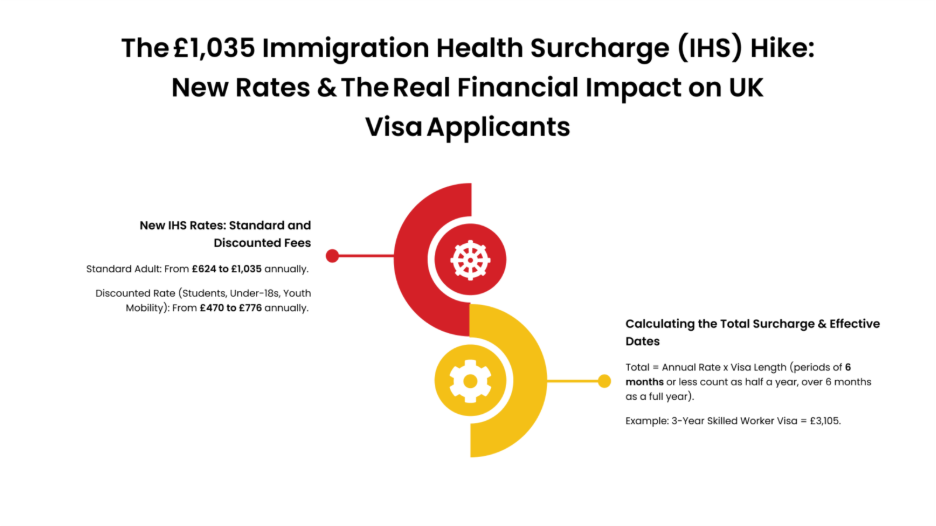
| Applicant Category | Previous Annual Rate (Approx) | New Annual Rate (from Feb 2024) |
| Standard Adult (Most Routes) | £624 | £1,035 |
| Discounted Rate (Students, Under-18s, Youth Mobility) | £470 | £776 |
Calculating the Total Surcharge & Effective Dates
The total surcharge multiplies the annual rate by the number of years of the visa. Crucially, any period of six months or less counts as half a year, and any period over six months counts as a full year.
- Example 1: Skilled Worker (3-Year Visa): An adult applicant now pays 3 x £1,035 = £3,105.
- Example 2: Student (4-Year Degree): Example 2: Student (4.5-Year Visa, e.g., a 4-year degree): A student applicant now faces 4.5 x £776 = £3,492.
The Cumulative Cost: IHS and Visa Fees Combined
The IHS is paid in addition to the main visa application fee, which constitutes a massive upfront financial outlay required before the application decision.
At a Glance: Family Visa Example
A five-year Family Visa application for a family of four (two adults, two children) at the new discounted rate of £776 per person per year, will now cost an estimated £18,110 in IHS fees alone. This does not include the visa application fee.
Disproportionate Impact on Families and Dependants
The increase hits families hardest, as each Dependant Applicant (spouse/partner and children) must pay the surcharge.
- Example: A family of two adults and two children applying for a five-year Family Visa now faces a total of £18,110 in IHS alone. This figure imposes a significant barrier for families pursuing life in the UK.
Broader Policy Implications for UK Immigration
The increased IHS and application fees signify a shift towards a revenue-centric immigration policy, erecting substantial financial barriers that disadvantage lower-income migrants and students. This high-cost structure risks narrowing the UK’s talent pool by excluding individuals without major savings.
Access and Inclusion: Barriers for Lower-Income Migrants
The increased financial demand creates a significant barrier for talented individuals and students who lack substantial savings.
IHS Payment Does Not Grant Access to Public Funds
You must understand a key legal distinction: payment of the IHS does not constitute access to Public Funds. Migrants who have paid the IHS are still subject to the No Recourse to Public Funds (NRPF) condition on their visa unless specifically exempt.
Financial Hardship: Case Studies
- Skilled Worker Scenario: A sponsored laboratory technician, not exempt under the Health and Care Visa route, now faces a £5,175 IHS bill for a five-year visa, making the move financially precarious.
- Start-up Scenario: An entrepreneur must pay the £1,035 rate annually, reducing the capital they require to invest in their new business.
Legal Obligations and Consequences of Non-Payment

Paying the IHS is a mandatory legal obligation. Failure to meet this requirement has serious consequences.
The Application Process: Paying the Surcharge
You must pay the IHS in full via the official UK government portal before you pay the visa application fee and submit your application.
- Mandatory Requirement for a Valid Application: Payment of the correct IHS amount is one of the Substantive Requirements for a valid visa application. Failure to pay the correct amount means the Home Office will not consider your application valid, leading to immediate rejection.
While the Home Office may allow a brief rectification period for underpayment, they are under no obligation to do so. Failure to provide the correct IHS payment promptly will result in the refusal of your application under the Immigration Rules.
Your Essential Next Step: Expert Legal Guidance from JRI Solicitors in Glasgow
JRI Solicitors provides authoritative and reassuring legal support, underpinned by our commitment to clients in Glasgow and across Scotland. We don’t just process paperwork; we safeguard your future by mastering the complexities of UK immigration finance and law.
JRI’s Expertise: Ensuring Compliance and Clarity
- Pre-Application Financial Planning: We perform meticulous calculations of the exact IHS and visa fee liability for every applicant. We verify your financial evidence to ensure you meet both the IHS payment and the wider maintenance requirements.
- Overcoming Administrative Review Challenges: If the Home Office makes an error in your application decision, we manage the Administrative Review process on your behalf. We present robust arguments to overturn incorrect decisions swiftly.
Your Trusted Legal Partners in Glasgow
We operate with unmatched local expertise in Glasgow, providing a clear path through the toughest UK immigration challenges. Our solicitors also clarify complex legal terms for you:
- Appellant: A person who lodges an appeal against an adverse immigration decision.
- Deportation: The compulsory removal of a person from the UK.
- Indefinite Leave to Remain (ILR): The permanent settlement status that waives the future needs to pay the IHS.
Our Solicitors providethe trusted, expert advice you need to ensure full compliance and confidence. Our Glasgow-based team of lawyers and solicitors stands ready to act immediately on your behalf, safeguarding your application against refusal.
Contact JRI Solicitors today to book your consultation and secure your application’s success. Act now to budget and plan effectively under the new regulations.