
Facing deportation is arguably the most terrifying crisis in immigration law, threatening to sever established ties to your family, home, and community. The one path to victory in these high-stakes cases hinges on meeting a specific, demanding legal test: proving “Unduly Harsh Consequences.” This test is the definitive legal shield protecting your family life under Article 8 ECHR.
At JRI Solicitors, we provide the specialised, aggressive representation required to meet this exceptionally high standard. Our expert lawyers master the precise Case Law and Precedent that defines the “unduly harsh” threshold in UK courts. We offer the absolute clarity and confidence needed to challenge a removal decision, ensuring your family’s future in Scotland is defended with authority.
Defining the Statutory Test in Deportation Appeals
When the Home Office issues a deportation order, they assert that the Public Interest in removing you (often linked to criminal conduct) outweighs your right to family life. Your appeal must prove that this balance is fundamentally wrong due to the severity of the consequences. JRI lawyers immediately dissect your case to construct this powerful counterargument.
The Legal Framework: Section 117B NIAA 2014
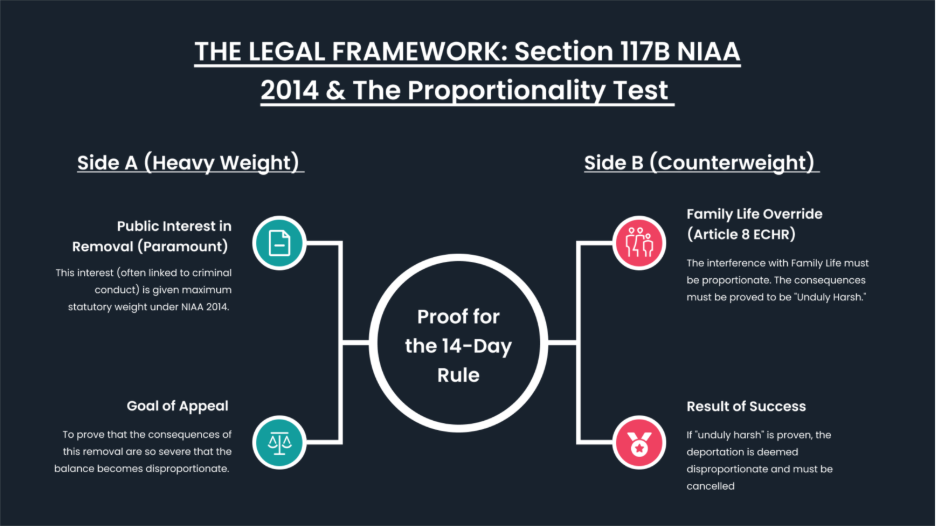
The law mandating this complex balancing act is found in Section 117B of the Nationality, Immigration and Asylum Act (NIAA) 2014. This legislation frames the consideration of Article 8 ECHR (Right to respect for private and family life) in all deportation cases.
- Public Interest is Paramount: For deportation cases, especially those involving foreign criminals, the Public Interest in removal is given maximum statutory weight. This makes the appeal difficult, as the public interest is assumed to be served by removal.
- The Family Life Override: The law requires that any interference with Family Life must be Proportionate. If the consequences of deportation are found to be “unduly harsh,” the deportation is deemed disproportionate and must be cancelled.
What is “Unduly Harsh”?
This is the single most critical piece of legal jargon in your appeal, and its meaning is strictly controlled by high court rulings. It does not mean merely harsh or unpleasant—it is an extremely high bar.
The Critical Distinction: The Supreme Court has unequivocally ruled that “unduly harsh” means the consequences must be significantly excessive compared to the hardship generally encountered when families are separated by immigration control. You must show an impact that is truly exceptional.
- JRI’s Strategic Advantage: We rely on leading UK Supreme Court judgments (such as KO (Nigeria)) to structure your evidence precisely around what the Tribunal Judge will accept. We certify that your family’s suffering goes well beyond the normal expectation of hardship, effectively translating your personal crisis into compelling legal terms.
Winning Proof: Targeting Consequences on Family Members
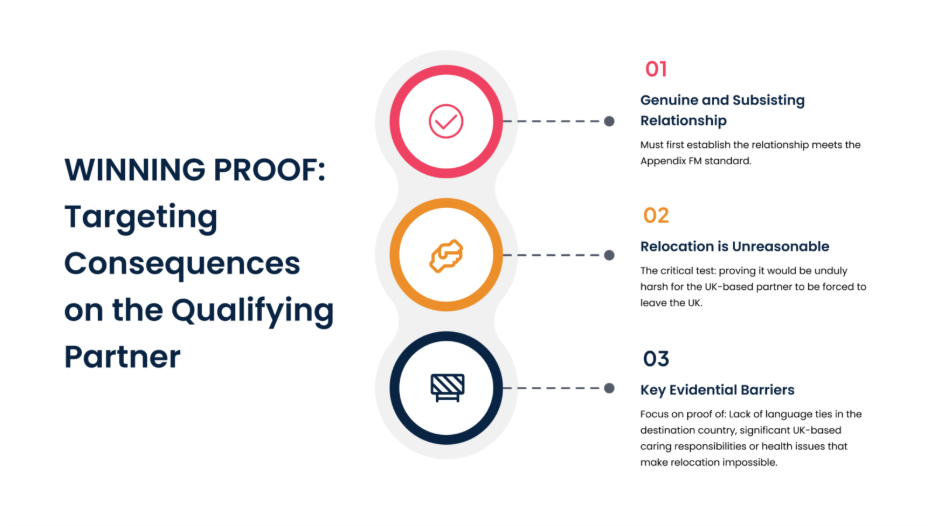
Our legal strategy breaks the case down, focusing specifically on the unique, devastating impact of deportation on the Qualifying Child and the Qualifying Partner. We build your case around these two mandatory proofs.
1. Focusing on the Impact on Qualifying Children

If the person being deported has a child who is a British citizen or has lived in the UK for seven continuous years, the legal duty is heightened.
- The Mandatory Section 55 Duty: Section 55 Borders Act 2009 places a mandatory duty on the Tribunal to consider the Best Interests of the Child as a primary consideration. We use this legal mandate to argue that removal will fundamentally undermine the child’s welfare.
- Proving Exceptional Circumstances for the Child’s Welfare: We focus on evidence that makes removal impractical or cruel. Evidence often includes:
- Specific Educational Needs: Reports proving a child’s complex educational requirements (e.g., severe learning disabilities) that cannot be met in the destination country.
- Health Dependency: Medical reports certifying a child’s dependence on highly specialist, non-transferable UK medical services.
- Psychological Harm: Expert reports confirming severe psychological trauma if separated from the appellant, a key factor in meeting the “unduly harsh” test.
2. Focusing on the Impact on the Qualifying Partner
Where the deportee has a partner (spouse, civil partner, or Unmarried Partner) who is a British citizen or settled in the UK, we focus on the extreme difficulties faced by the partner.
- Proving Genuine and Subsisting Relationship: We first establish the relationship meets the Appendix FM standard.
- Relocation to the Home Country is Unreasonable: The crucial test is whether it would be unduly harsh for the UK-based partner to be forced to leave the UK. We gather evidence to prove:
- Lack of Ties: The partner possesses no language skills, cultural ties, or support network in the destination country.
- UK-Based Responsibility: They have significant caring responsibilities for their own UK-based relatives (e.g., elderly parents) that cannot be abandoned.
- Serious Health Issues: They suffer from serious health or mobility issues that make relocation medically inadvisable or practically impossible.
Evidence and Representation: JRI’s Strategic Excellence

An appeal is won or lost long before the Tribunal hearing, based on the quality of the evidence and the strategic legal structure. Our lawyers apply strategic excellence to every document.
Collecting Compelling Evidence to Meet the High Bar
To prove the “unduly harsh” threshold, you must present professional, objective evidence that goes beyond simple family letters. We guide you precisely on what to collect:
| Evidence Category | Required Document Type | Purpose in Appeal |
| Medical/Welfare | NHS Consultant/Specialist Reports, Social Worker Assessments | Proves severity of illness or welfare dependency in the UK. |
| Educational | Letters from Head Teachers, Educational Psychologists | Proves unique needs or disruptive effects on a child’s development. |
| Financial/Housing | Financial statements, Tenancy Agreements, Deed Polls | Proves the appellant’s critical role in the family unit’s stability. |
| Expert Testimony | Independent Psychological Assessment (P.A. Report) | Crucial for confirming psychological trauma and meeting the “unduly harsh” test. |
The Power of Legal Drafting
The Home Office refused your application with a detailed legal rationale. We counter it with an even stronger one.
- Dismantling the Proportionality Test: Our solicitors draft a comprehensive Skeleton Argument that explicitly addresses—and dismantles—each point raised in the refusal letter. We structure the case to show the Judge exactly how the Home Office failed the Proportionality Test.
- Mastering the Burden of Proof: The Burden of Proof is firmly on you. We ensure that our legal submissions are authoritative, transparent, and legally precise, leaving no room for doubt that the evidence meets the high statutory standard.
JRI Solicitors: Authority in UK Tribunal Appeals
We stand as trusted experts in UK immigration appeals, highly visible and successful across Glasgow and Scotland for our appeal work. We convert fear into effective legal action.
- Representation at the Tribunal Hearing: We provide detailed representation at the Tribunal Hearing itself, expertly presenting evidence, cross-examining witnesses, and making concluding legal submissions to the Judge to secure a positive determination.
- Strategic Bail Advice: Where the appellant is detained, we provide urgent advice and representation for Bail Pending Appeal, arguing for release so they can better prepare their case from home with their family.
Secure Your Family Life—Act Now
The legal test of “Unduly Harsh Consequences” is your most powerful tool against deportation, but it is one of the most difficult to satisfy. It requires specialist knowledge, precise evidence, and authoritative Legal Drafting.
Do not risk your family’s security by underestimating this legal threshold.