
Being subject to a 10-year ban from re-entering the United Kingdom is a devastating legal penalty that severely impacts individuals and families. This sanction effectively closes the door on future opportunities, family reunification, and a return to the UK. However, the situation is not irreversible.
At JRI Solicitors in Glasgow, we focus on providing clarity and confidence in the face of these complex challenges. Our expert immigration lawyers understand the precise legal mechanisms available within UK law to challenge or lessen this exclusion period. We deliver the specialist knowledge required to effectively pursue a waiver or a successful appeal, guiding you toward a resolution and the opportunity to re-enter the UK sooner.
We transform this serious challenge into a clear, actionable strategy for re-entry. Trust our expertise to fight for your future.
Understanding the Authority of the 10-Year Re-Entry Ban

The 10-year re-entry ban is one of the most severe sanctions the Home Office can impose under the UK Immigration Rules. It reflects a firm’s stance against serious breaches of immigration law. Understanding the legal foundation and specific triggers is the essential first step toward building a successful challenge, a step our JRI lawyers help you take with authority.
What Triggers a 10-Year Exclusion Period?
This extensive exclusion period is primarily triggered by governmental actions related to serious non-compliance or deception. Our solicitors review the decision notice to confirm the exact basis for the ban.
The most common triggers include:
- Deportation Orders: Issued by the Secretary of State, often following a criminal conviction where an individual’s presence is deemed not conducive to the public good. A Deportation Order automatically carries a 10-year ban.
- Specific Removal Directions: While many removals carry shorter bans (one or five years), the 10-year period is imposed if the person failed to comply with a previous order, absconded, or left the UK using public funds.
- Deception or False Representations (Paragraph 320(7A) and 320(7B)): This is one of the most common and difficult grounds, applied when the Home Office believes an applicant used false representations, documents, or failed to disclose material facts to obtain a visa or residency. The ban applies even if the deception was used in a previous, separate application.
- Our Challenge Strategy: The Home Office must meet the required Burden of Proof to demonstrate deception. Our expert team scrutinises the evidence used by the Home Office, often successfully challenging the finding of deception itself, particularly in cases involving administrative error or honest misunderstanding rather than deliberate fraud.
The Statutory Basis in UK Immigration Law
The authority to issue an exclusion is not arbitrary; UK legislation firmly roots this power. Our legal team applies the following regulatory framework daily:
- Immigration Act 1971: Provides the foundational legal powers for controlling entry and stay in the UK.
- Immigration Rules: Detail the specific, constantly updated rules that govern all visa and entry clearances, outlining the conduct leading to exclusion in the General Grounds for Refusal.
- UK Borders Act 2007: Strengthened the powers regarding deportation, solidifying the 10-year period for serious cases, particularly involving foreign criminals.
The Legal Routes: Waivers and Human Rights Applications
A re-entry ban is not a final judgment. UK Immigration Law provides specific routes to seek Discretionary Consent to Re-Enter or to use human rights law to compel the Home Office to reduce or waive the exclusion period entirely. These routes demand precise legal arguments and robust evidence.
1- Applying for Discretionary Consent to Re-Enter

This process involves a direct, non-statutory application to the Home Office, requesting they exercise their discretion to lift the ban. Success hinges on demonstrating strong, compelling factors that outweigh the public interest in maintaining the exclusion.
Assessing Deportation Hardship: JRI’s Approach
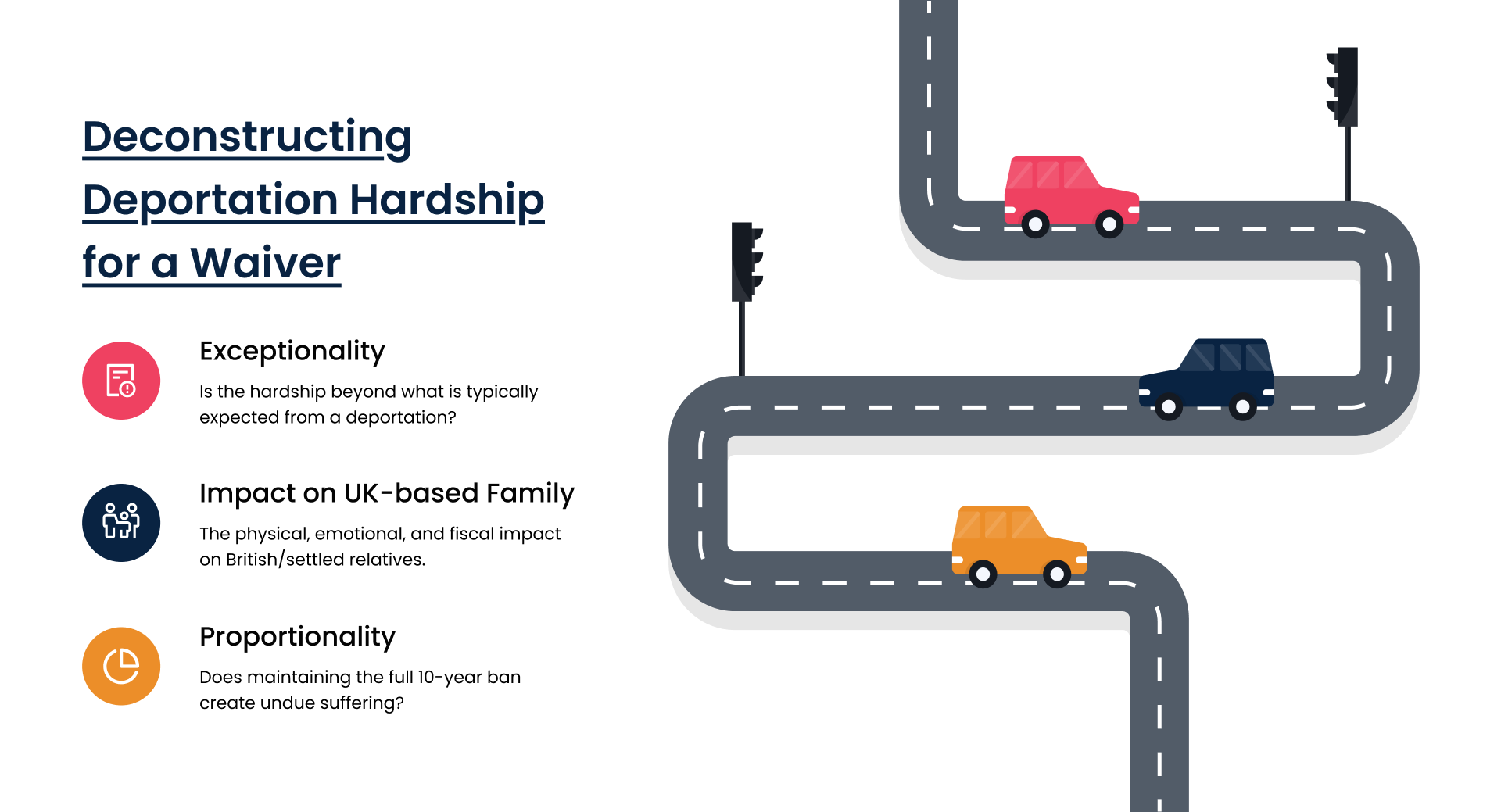
The Home Office will assess the degree of Deportation Hardship, the significant difficulties, distress, or impact that the exclusion period causes.
| Hardship Element | Assessment Focus | JRI’s Strategy |
| Exceptionality | Is the hardship beyond what is typically expected from a deportation? | We frame your circumstances as unique and severe. |
| Impact on UK-based Family | The physical, emotional, and fiscal impact on British/settled relatives. | We secure strong psychological and dependency evidence. |
| Proportionality | Does maintaining the full 10-year ban create undue suffering? | We argue that proportionality requires immediate reduction or waiver. |
Compelling Circumstances: The Evidence You Need
A waiver application must prove truly Compelling Circumstances. Our expert team guides you to compile the necessary proof:
- Grave Illness: Medical reports detailing severe, life-threatening illness of a UK-based relative, where the excluded person is the primary or sole carer.
- Best Interests of a Child: Documentation proving the exclusion is detrimental to the welfare and development of a child who is a British citizen or settled in the UK (a primary consideration under UK law).
- Rehabilitation and Conduct: Proof of significant character reform, rehabilitation, or exemplary conduct since the original offence or deception.
- New Evidence: Information that was not available or considered during the original removal decision that now undermines its validity.
2. The Human Rights Route: Article 8 Applications
Where an individual has family or a private life established in the UK, Article 8 ECHR offers a powerful legal route to challenge a ban. Article 8 of the European Convention on Human Rights (ECHR) protects the right to respect private and family life.
The Home Office must assess whether enforcing the 10-year ban is Proportionate to the legitimate public aim of maintaining effective immigration control. Our role is to demonstrate that the interference with your established life and relationships is disproportionate, meaning the negative consequences of the ban far outweigh the public benefit of enforcing it for the full 10 years. Our solicitors are skilled at constructing this complex proportionality argument using the latest case law.
Focusing on Family Life
This is particularly relevant for those with a partner or children who are British citizens or settled in the UK.
- We focus on evidence proving the genuine and subsisting nature of your relationship (cohabitation, shared finances, etc.).
- We make strong, legally backed submissions concerning the best interests of any children involved.
Urgent Legal Advice: Do not Face the Ban Alone
JRI Solicitors specialises in overturning or mitigating these complex legal penalties. Our Glasgow-based experts are ready to review your case now.
Call our dedicated line today for a confidential, immediate consultation.
Strategic Steps for Challenging the Decision
In addition to seeking a waiver, a successful strategy may involve challenging the legal foundation of the decision that triggered the 10-year ban in the first place. JRI’s experienced litigators assess all available avenues simultaneously.
Reviewing the Original Decision: Appeals and Judicial Review
If the original Deportation Order or refusal was flawed, a direct legal challenge can invalidate the ban itself.
- Strict Adherence to Time Limits: Time limits for appeals and applications for Judicial Review are extremely strict and non-negotiable. Missing a deadline can irrevocably close off your legal avenue. Our Glasgow team acts immediately upon instruction to ensure compliance.
- Grounds for a Legal Challenge: Successful appeals typically focus on:
- Error of Law: The Home Office misapplied the Immigration Rules or relevant statutes.
- Procedural Impropriety: The Home Office failed to follow its own published procedures, which prejudiced your case.
- Breach of Human Rights: The decision violated Article 8 ECHR.
The Indispensable Role of Precedent (Case Law)
UK courts, including those with jurisdiction in Scotland, rely heavily on Precedent—previous binding legal rulings—to decide current cases. Our expert lawyers leverage established case law (specific Upper Tribunal or Court of Appeal decisions) to argue that the Home Office’s decision conflicts with established legal principles. This expertise in applying relevant legal rulings is a cornerstone of our ability to secure positive outcomes.
How JRI’s Solicitors Assist You
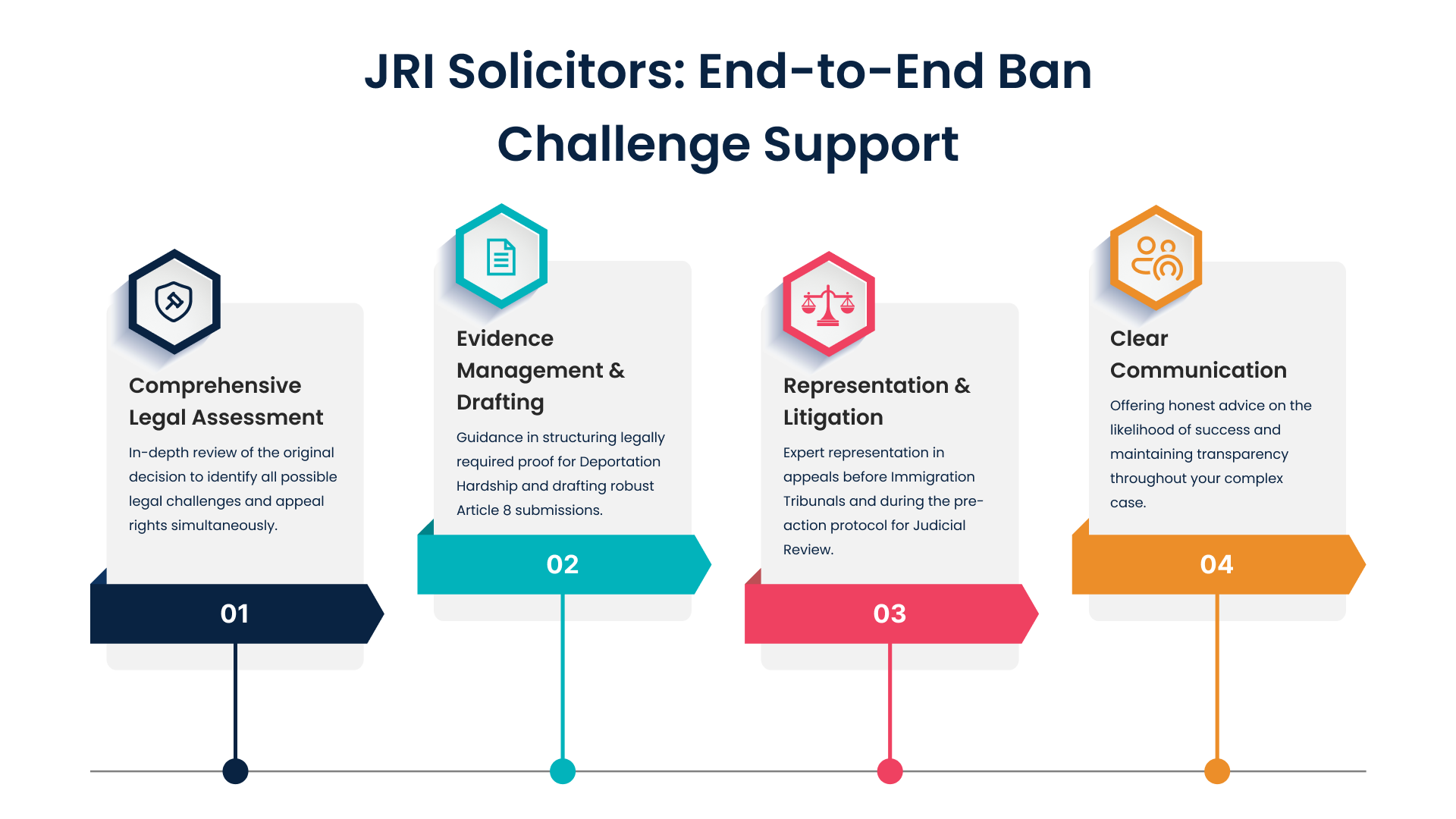
We provide comprehensive, end-to-end support at every stage, maximising your opportunity for a successful outcome.
- Comprehensive Legal Assessment: We conduct an in-depth review of the original decision to identify all possible legal challenges and appeal rights.
- Evidence Management: We guide you in gathering and structuring legally required proof of Deportation Hardship and Compelling Circumstances.
- Expert Drafting: We draft and submit legally robust applications for Discretionary Consent to Re-Enter and powerful Article 8 Human Rights submissions.
- Representation: We represent you in appeals before the Immigration Tribunals and during pre-action protocol for Judicial Review.
- Clear Communication: We offer clear, honest advice on the likelihood of success, maintaining transparency and open communication throughout your complex case.
Take control of your future and challenge the 10-year ban. Contact JRI Solicitors in Glasgow today.