
The UK Skilled Worker Visa route has seen massive shifts, particularly concerning the minimum salary threshold. For existing visa holders and their sponsors in Scotland and Glasgow, the immediate question is pressing: Do you need to meet the headline rate of £41,700 for your next extension, or are you protected by Transitional Provisions?
This confusion poses a significant legal risk. An incorrect extension application based on an insufficient salary will lead to visa refusal and severe consequences for both the worker and the sponsoring company.
At JRI, our expert solicitors specialise in identifying your exact legal classification. We clarify the complex rules to confirm the precise, legally compliant salary required for your next extension. We provide the legal certainty you need to protect your status and long-term residency plan.
The Urgency: Why Your Next Extension Requires Immediate Review
The recent implementation of new salary and skills thresholds has created a crisis point. Failure to recognise the correct deadline for your application means the difference between stability and refusal.
The New Standard: Understanding the General Salary Uplift
We must establish the high bar that applies to those not covered by protective rules.
- Defining the Post-July 2025 General Threshold (£41,700)
- The highest new minimum salary for standard Skilled Worker applications (Option A) is £41,700 per year, effective 22 July 2025.
- This threshold applies to most new Skilled Worker applications and all extension applications that fail to qualify for the necessary transitional relief.
- Our lawyers emphasise: This is the rate you must plan for if your initial Certificate of Sponsorship (CoS) was issued on or after 4 April 2024.
- The Critical Change: New Going Rate Calculations (50th Percentile)

The UKVI now calculates the ‘Going Rate’ for specific jobs (SOC Codes) based on the median (50th percentile) of UK earnings data.
The Impact: This change means the occupation-specific salary requirement (the Going Rate) may be significantly higher than the £41,700 general threshold. Your salary must always meet whichever is higher—the general threshold or the occupation-specific rate.
The Risk of Incorrectly Applying for an Extension
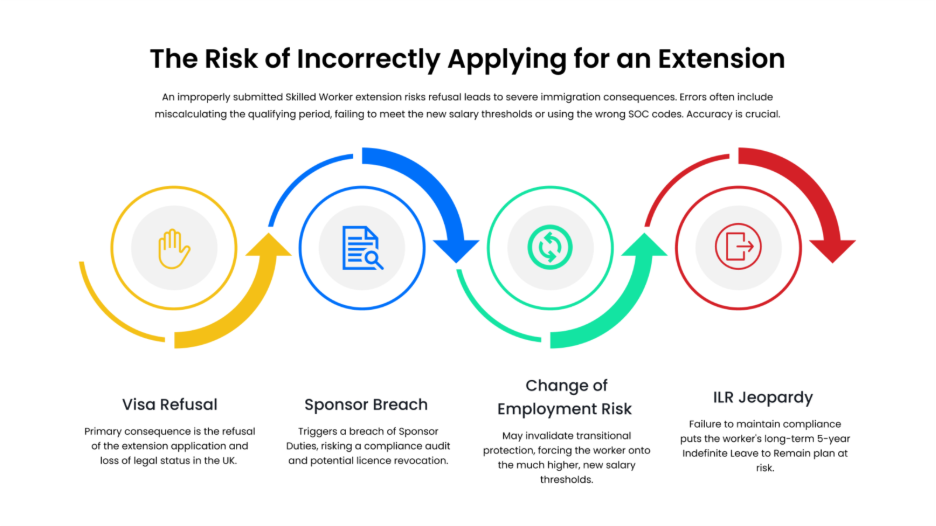
An error in calculating the salary requirement is a serious breach of compliance with immediate, negative consequences.
- Consequences of Failure: Visa Refusal and Sponsor Compliance Issues
- Visa Refusal: The primary consequence is the refusal of the visa extension, leading to the potential loss of legal status and the requirement to leave the UK.
- Sponsor Breach: For the employer, a salary failure is a serious breach of Sponsor Duties. This can trigger a Home Office compliance audit and potentially lead to a downgrade or Revocation of the sponsor licence.
- The Key Distinction: Extension vs. Change of Employment
- Extension: Usually means continuing the same job with the same employer (under the same SOC code). This is the scenario most likely to preserve transitional protection.
- Change of Employment: This involves a new job with a different SOC code or a new employer. This requires a fresh application and may invalidate transitional protection, subjecting the worker to higher, new thresholds. We provide clear counsel on whether your job change is permissible under the old rules.
Securing Your Status: Who Qualifies Transitional Protection?
The key to transitional protection eligibility lies in the date of your initial sponsorship. If your first Certificate of Sponsorship (CoS) for a Skilled Worker or Tier 2 (General) visa was assigned before April 4, 2024, you qualify for these transitional rules. This allows you to apply for extensions and settlement under a lower general salary threshold and different ‘going rate’ calculations than new applicants, providing continuity for your existing status until April 4, 2030.
The Key Date for Transitional Salary Rules
Eligibility is determined by a single, non-negotiable date linked to the start of the process.
- Defining the ‘Existing Worker’: CoS Issued Before 4 April 2024
- The trigger for the most favourable transitional protection is that the worker’s first Certificate of Sponsorship (CoS) for the Skilled Worker (or Tier 2 General) visa must have been issued on or before 3 April 2024.
- Warning: Leaving the Skilled Worker route and returning (a break in continuous permission) resets the clock, placing the worker under the higher, new salary requirements.
- The Expiration of Protection: Why You Must Act Before 4 April 2030

The transitional arrangements, including the lower salary requirements and the lower going rates, are only valid for applications (extensions or ILR) made before 4 April 2030.
This absolute deadline creates maximum urgency for long-term planning, as applications submitted after this date will automatically be subject to the full, much higher thresholds applicable at that time.
The Protected (Lower) Salary Thresholds
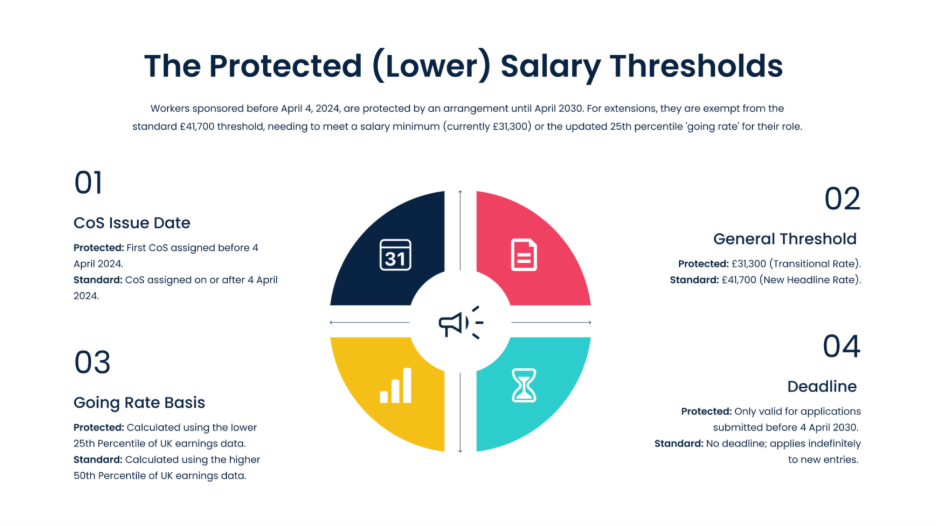
If you qualify for transitional protection, you benefit from significantly lower salary requirements compared to new applicants.
- Transitional General Threshold vs. Transitional Going Rate (Whichever is Higher)
Protected workers must meet whichever is higher of the following two amounts:
| Component | Rate (Effective 22 July 2025) | Based On |
| Transitional General Threshold | £31,300 | A fixed general rate for existing workers. |
| Lower Going Rate | Calculated at the 25th percentile of UK earnings. | The specific occupation (SOC Code). |
- Available Discount Options (Tradeable Points F-J) for Existing Workers
- Existing workers may still utilise specific salary discount options (Tradeable Points F-J) to lower the salary further (down to a minimum of £25,000 in some cases).
- Examples of Tradeable Points: These options cover existing workers who meet specific criteria, such as being a ‘new entrant’ at the start of their career, or holding a relevant PhD qualification. We confirm which options are legally available for your specific case.
Critical Deadline Alert: Act Before 4 April 2030!
The Transitional Provisions are time-limited. If your next Skilled Worker extension is not planned correctly, you risk losing the benefit of the lower £31,300 salary threshold, forcing you to meet the £41,700 rate or higher. JRI’s expert lawyers on hand in Glasgow provide the immediate salary compliance audit you need.
Don’t risk your UK status. Secure your eligibility now and contact JRI for an urgent strategy consultation.
JRI’s Strategic Review: Assessing Your Future Compliance
JRI’s strategic review is crucial for long-term security, moving past just the next visa extension. We audit your status against the requirements for Indefinite Leave to Remain (ILR), identifying any potential future salary liabilities, including the increase to the minimum £38,700 requirement, ensuring a fully compliant and predictable path to settlement.
Strategic Compliance for Existing Visa Holders
We simplify the complex rules on skill levels and salary calculation to provide a clear path.
- Calculating the Exact Salary Requirement for Your Next Extension
- JRI’s Service: We map the worker’s current SOC code to the Lower Going Rate table (25th percentile data) applicable at the time of their application.
- We apply the relevant Tradeable Points (if applicable) and confirm the precise, minimum legally required salary for their next extension application, providing legal certainty that your CoS will not fail.
- Impact of RQF Level Changes on Sub-Degree Roles (RQF 3-5)
- The Rule: The minimum skill level for new applicants increased to RQF Level 6 (degree level).
- Protection: Transitional provisions allow workers sponsored in RQF Level 3-5 roles before the change to continue and extend in that same role (under the same SOC code), despite the skill level increase for new applicants. JRI ensures your extension paperwork properly invokes this protection.
The Path to Indefinite Leave to Remain (ILR)
The goal of many Skilled Workers is settlement. This goal is now subject to heightened salary scrutiny.
- Ensuring Continued Eligibility Under the 5-Year ILR Rule
- While there are ongoing policy discussions regarding increasing the general ILR qualifying period to ten years, existing Skilled Workers should still qualify for the 5-year ILR route, provided they maintain continuous lawful residence.
- We confirm your accumulated qualifying time and manage any necessary Absence Calculations to protect your ILR eligibility.
- The New Risk: Meeting Higher ILR Salary Thresholds Post-July 2025
- Warning: Even with transitional salary protection during extensions, the ILR application itself (made after 5 years) may be subject to a higher, dedicated settlement salary threshold.
- For ILR, you must meet the higher of the new general settlement thresholds (e.g., £41,700 for standard cases) or the refreshed Going Rate for the occupation. JRI provides long-term salary forecasting to ensure the employer is ready for this final pay increase.
Actionable Steps: JRI’s Legal Assurance in Glasgow
Our legal assurance process in Glasgow provides indispensable local support, extending beyond mere application filing. We leverage our deep expertise in both UK immigration and specific Scottish employment law nuances, ensuring that every aspect of your visa application, particularly salary and job role compliance, is reviewed. This local presence guarantees a seamless, fully compliant process that mitigates risks and provides maximum confidence in securing your status.
Our Role in Managing Sponsor and Applicant Compliance
We provide hands-on legal management for both the sponsor and the worker.
- Preparing the Extension Application and New Certificate of Sponsorship (CoS)
- We manage the sponsor’s assignment of a new Defined or Undefined CoS, ensuring the salary data is populated accurately under the transitional rules.
- We prepare the entire application file, ensuring all documentation (e.g., payroll evidence and employment contracts) fully supports the salary claim, meeting the high evidentiary burden.
- Addressing Dependants: Aligning Visa Expiries and Requirements
- We advise clients on managing their family’s status. We ensure that dependants’ visas are aligned with the main applicant’s extension timeline, preventing gaps in their leave to remain.
- We confirm they meet the updated financial maintenance requirements, securing the entire family’s future in Scotland.
The moment to act is now. Do not risk a refusal based on miscalculation.
JRI Solicitors offers authoritative, precise legal analysis to confirm your salary under the Transitional Provisions, protecting your path to ILR in Scotland.
Call us today to secure your essential salary compliance consultation.