The Health and Care Worker Visa are a critical lifeline for the UK’s social care sector, particularly here in Scotland and Glasgow. While demand for roles like Care Workers (SOC 6135) is immense, UK Visas and Immigration (UKVI) maintain elevated scrutiny on applications. This often leads to preventable visa refusals, resulting in costly delays, severe staff shortages, and significant distress for applicants.
You need more than general advice; you need precise legal compliance. At JRI, our expert immigration lawyers specialise in turning high-risk applications into secured permissions. We achieve this by focusing on the Top 3 Reasons for Refusal: Salary Traps, Genuineness Concerns, and Documentation Errors. We eliminate the risk before your application reaches the Home Office.
The High-Volume Risk: Understanding UKVI Scrutiny
The high volume and sensitive nature of the Health and Care route mean that every application is scrutinised to an elevated degree. We recognise and appreciate the gravity and complexity inherent in the regulatory environment for this sector. This understanding is something we view as a core responsibility, and it shapes how we approach our planning and execution, ultimately fostering a more secure and compliant working relationship.
The Sensitive Nature of the Health and Care Route
UKVI’s vigilance in this sector serves a specific purpose, which sponsors must fully appreciate.
- UKVI’s Focus on Preventing Modern Slavery and Exploitation
- UKVI applies heightened scrutiny to this sector primarily to prevent the abuse of the visa system and the potential for worker exploitation or modern slavery.
- This focus means sponsors must meet high ethical standards and demonstrate robust HR practices that safeguard the worker’s welfare—something our solicitors verify during our compliance checks.
- Consequence: Increased Scrutiny on Low-Paid Roles (SOC 6135/6136)
- Roles such as Care Workers (SOC 6135) and Senior Care Workers (SOC 6136) are subject to the tightest restrictions under the UK Immigration Rules following the April 2024 changes.
- Crucial Restriction: There is now a prohibition on new applicants in these specific SOC codes from bringing dependants (partners or children) to the UK. This confirms the low-paid nature is now a distinct risk factor.
- Note: Nursing Auxiliaries (SOC 6131) is often treated separately due to its direct link to registered nursing environments, demonstrating the need for precise legal categorisation.
JRI’s Role in Compliance: Pre-Application Risk Assessment
We leverage our specific geographical and regulatory knowledge to secure applications in Scotland.
- Our Expertise in Glasgow/Scotland Care Sector Regulation
- While the Care Quality Commission (CQC) applies to England, we focus on the specific regulatory framework in Scotland, such as requirements set by the Care Inspectorate.
- This local knowledge ensures that your application is not only compliant with UKVI rules but also aligns with the standards expected of a genuine care provider in Glasgow and across Scotland.
- Addressing Transitional Provisions and Dependant Rule Changes
The Dependant Ban for care workers took effect on 11 March 2024. We provide the essential legal clarification needed for existing visa holders.
- Dependant Ban Date: The prohibition applies to all applications submitted on or after 11 March 2024.
- Transitional Protection: Transitional Provisions protect those who held a Health and Care Worker Visa (or submitted an application) before that date.
- Our lawyers carefully assess the main applicant’s immigration history to confirm their eligibility for these critical exemptions.
Top Refusal Reason 1: The Salary Threshold Trap
Salary failures are common and entirely preventable. The UKVI applies a complex dual test that sponsors often misunderstand, leading to immediate refusal. This test requires the offered salary to satisfy both the general minimum threshold and the specific ‘going rate’ for the role’s occupation code, whichever figure is higher. Failing to check both figures is the root cause of many application rejections.
The Dual Salary Test for Health and Care Roles

The Health and Care route benefits from exemptions to the general Skilled Worker threshold, but this nuance is where many errors occur.
- Meeting the General Threshold vs. The ‘Going Rate’
- The applicant must be paid the highest of the following two amounts:
- The specific minimum threshold for Health and Care workers, which is £25,000 per annum.
- The full Going Rate for the specific SOC code (Standard Occupational Classification).
- Exclusion of Unallowable Pay Elements
- UKVI is strict: only guaranteed basic gross pay is considered towards the salary threshold.
- Mandatory Exclusions: You cannot include overtime, bonuses, commissions, or allowances (unless specifically permitted). This focus on basic pay means sponsors must structure contracts carefully to avoid inflating the apparent salary.
Compliance Checklist for Sponsor Salary Compliance
We provide the definitive process for calculating legally compliant salaries, ensuring accuracy every time.
- Calculating the Correct Salary for Experienced Workers and New Entrants
- The Tradable Points system allows for a reduced salary threshold if the applicant qualifies as a New Entrant (e.g., is under the age of 26).
- Even when using Tradable Points, the salary must still meet the minimum £25,000 floor (or the relevant proportion of the going rate). Our lawyers ensure this calculation is precise and accurately reflected in the Certificate of Sponsorship (CoS).
- The Impact of the Immigration Salary List (ISL) on Low-Paid Roles
- The Immigration Salary List (ISL) (replacing the Shortage Occupation List) provides a lower general salary threshold for listed roles.
- We confirm the status of low-paid codes like SOC 6135 and 6136 on the ISL and ensure the sponsor uses the correct lower rate justification where applicable. This saves you money while maintaining compliance.
Stop Costly Delays: We Mandate Compliance.
UKVI scrutiny of Health and Care Visas is at an all-time high, often resulting from basic salary and document errors. A single refusal can jeopardise your sponsor licence and delay staff deployment by months. JRI’s expert immigration solicitors in Glasgow provide a pre-submission compliance audit to eliminate these risks.
Protect your licence and secure your workers. Contact JRI today for an authoritative compliance consultation.
Top Refusal Reason 2: Failing the Genuine Vacancy Test
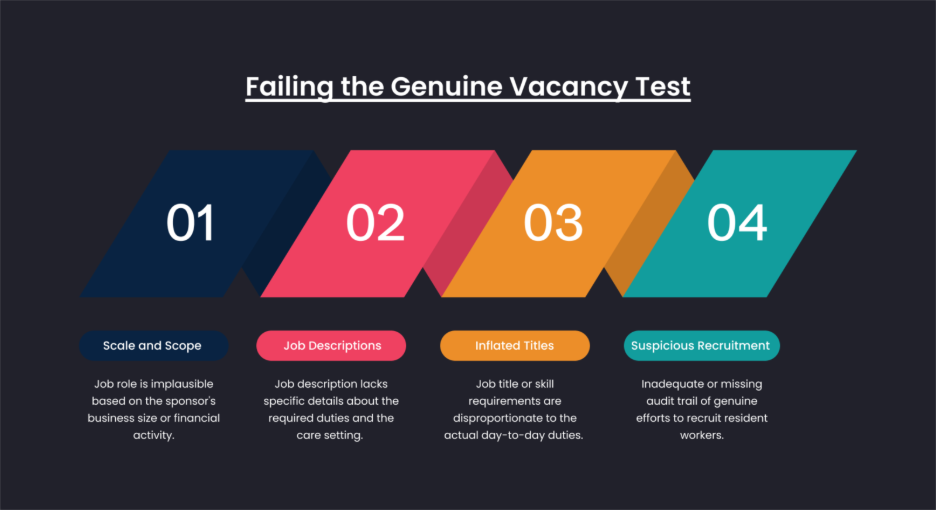
The Genuine Vacancy Test is a mandatory Suitability Requirement that ensures the job is real and necessary for the business, not created simply to secure a visa. This is a common pitfall in the high-volume care sector.
Defining a Genuine Vacancy under UK Immigration Law
The Home Office assesses the role’s authenticity by checking it against the business’s actual size and activities.
- UKVI’s Assessment Criteria (Scale of Business, Recruitment History)
- Scale and Scope: UKVI assesses the scale of the sponsor’s business (e.g., number of care beds, financial turnover) and the plausibility of the duties aligning with the business model.
- The Test: The Home Office looks for evidence that the role is not a sham or created primarily to enable the worker to gain entry. Our solicitors help you build the narrative that proves the genuine need for the role.
- Warning Signs: Generic Job Descriptions and Suspicious Recruitment
We provide specific warnings against using documentation that suggests manipulation:
- Generic job descriptions that lack specific details about the Scottish care setting.
- Inflated job titles or requirements that are disproportionate to the advertised duties.
- Failing to demonstrate genuine efforts to recruit resident workers (even if not strictly mandatory).
Mitigating Genuineness Concerns in High-Turnover Roles
High-turnover industries like care must be especially vigilant in documenting their staffing needs.
- The Importance of Documenting Recruitment (Audit Trail)
- You must maintain a thorough Audit Trail of your recruitment process. This helps defend against a Genuine Vacancy challenge.
- Records to Keep: We instruct sponsors to maintain records of advertising dates, interview notes, and the rationale for selecting the overseas worker.
- Matching the SOC Code to Actual Duties (Avoiding Misclassification)
- This is a critical, technical error. Ensure the SOC code on the Certificate of Sponsorship (CoS) perfectly matches the worker’s actual duties as per the UKVI Appendix Skilled Occupations guidance.
- Misclassification occurs when a Care Worker (SOC 6135) is given a title suggesting a higher skill level. JRI guarantees accurate SOC code mapping for every role, eliminating this refusal risk.
Top Refusal Reason 3: Incomplete and Non-Compliant Documentation

The final common reason for refusal is failure to meet the exacting administrative standards set by the Home Office. This often stems from submitting incomplete applications or documents that fail the strict evidential quality test. Sponsors must ensure every piece of supporting paperwork is legible, certified correctly, and directly relevant to the visa requirements.
Errors Related to the Certificate of Sponsorship (CoS)
The CoS is the cornerstone of the application, and administrative errors here lead to immediate refusal.
- Invalid CoS: Expiry, Incorrect Data, or Sponsor Licence Suspension
- Validity: The CoS must be assigned no more than 3 months before the visa application is submitted. Using an expired CoS is an immediate ground for refusal.
- Sponsor Status: We also confirm the sponsor’s licence is active and not under review or suspension, a service essential for protecting the applicant.
- The CoS Explanation Box: Proving Eligibility for the Health and Care Route
- The CoS Explanation Box is your chance to directly communicate compliance to the caseworker.
- We ensure this section is used strategically to:
- Clearly confirm the role’s eligibility and the salary justification.
- Reference the use of Tradable Points or Transitional Provisions where applicable.
- Provide evidence that the Genuine Vacancy Test is met.
Applicant Financial and Suitability Failures
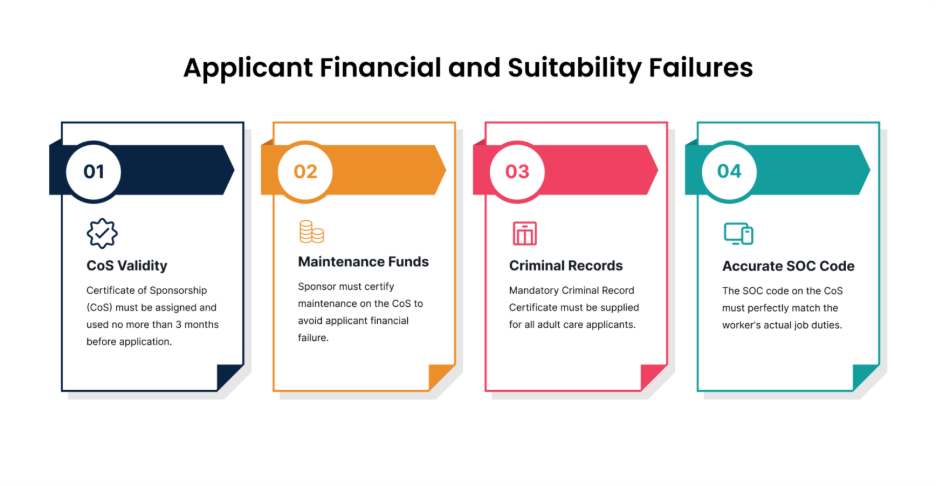
The applicant must satisfy UKVI’s Suitability Requirements and demonstrate financial independence.
- Proof of Maintenance Funds (The £1,270 Requirement)
- Applicants must show they hold at least £1,270 in their bank account for a continuous period of 28 days, unless the sponsor certifies maintenance.
- Our Advice: We strongly advise sponsors to certify maintenance on the CoS. This simplifies the applicant’s journey and removes a common refusal risk related to bank statements.
- Failing the Suitability Test (Criminal Records or Previous Breaches)
- A mandatory Criminal Record Certificate is required for care roles.
- Suitability Requirements cover previous immigration history. Failure to declare relevant criminal history, evidence of previous immigration breaches (e.g., overstaying), or providing false information will lead to refusal. We conduct a thorough pre-check of the applicant’s history to manage this risk.
JRI: Your Trusted Partner for Health and Care Sector Visas
We are specialists in securing the essential workforce for the Scottish care sector. Our expertise protects both the applicant and the sponsor by navigating the intricate Skilled Worker and Health and Care Visa routes. We ensure full compliance with Home Office regulations while efficiently managing the entire application process, guaranteeing a secure and timely placement of vital personnel.
Our Expertise in Sponsor Licence Protection in Scotland
We believe the best defence against refusal is a compliant, audit-ready sponsor licence.
- JRI’s Experience in UKVI Mock Audits and Compliance Training
- Our solicitors conduct internal Mock Audits that simulate a UKVI compliance visit. We review your HR systems and record-keeping against Appendix D requirements, providing concrete, actionable feedback.
- We offer bespoke compliance training to your HR staff, ensuring your internal processes safeguard the sponsor licence against future risk.
- Protecting Against Licence Revocation due to Refusal History
- Repeated visa refusals, particularly on Genuine Vacancy or salary grounds, can trigger a Home Office review, potentially leading to Sponsor Licence Revocation—the ultimate penalty.
- JRI’s commitment to quality applications is your assurance. We protect your licence by ensuring your refusal rate remains negligible.
Converting Refusal into Approval: JRI’s Action Plan
Even when a refusal occurs, our legal strategy provides a clear path forward.
- Strategic Review and Re-Application Strategy
- We conduct a rapid, in-depth legal review of the Refusal Notice, identifying the exact caseworker error or application flaw.
- We then formulate a strategic plan for a corrected re-application that directly addresses the UKVI’s concerns with robust, irrefutable evidence, maximising the chances of swift approval.
- Applying for Administrative Review (AR) Where Appropriate
- If the refusal was due to a clear caseworker error or a procedural mistake, JRI’s lawyers on hand will file an Administrative Review (AR).
- This formal challenge to the UKVI decision can save critical time and money compared to submitting a full new application, proving our expertise in decisive legal intervention.
The demand for Health and Care Workers in Scotland is too critical to risk preventable visa refusals. You need legal certainty that your application is compliant, genuine, and destined for approval. JRI Solicitors offers an authoritative, precise legal strategy for sponsors and applicants in Glasgow. Secure your workforce and peace of mind.