A previous visa refusal regardless of the visa type creates a significant hurdle for any new application to UK Visas and Immigration (UKVI). Your file now carries a “High-Risk” Flag.
The Entry Clearance Officer (ECO) will not assume good faith; they will check your file on the balance of probabilities to see if you have overcome the exact reason, you were previously denied. Re-applying without professional guidance virtually leads to a second refusal.
JRI specialises in these high-stakes re-applications. Our expert lawyers transform a history of refusal into a structured, legally robust submission. We deliver the clarity and strategic approach needed to satisfy the strict requirements of UK immigration law and secure your entry clearance. We are your necessary shield against repeat failure.
The High-Risk Flag: Why a Refusal Changes Everything
A previous refusal means your file carries institutional memory within the Home Office’s systems. The ECO’s primary concern shifts from vetting a new applicant to examining why you failed before, and whether you are being completely truthful now.
The Non-Negotiable Obligation to Disclose Past Refusals
Honesty is not optional; it is a legal requirement under the Immigration Rules. Failing to disclose any past refusal from the UK or any other country compromises your entire application.
The Requirement for Honesty on the Application Form:
- UKVI expects applicants to satisfy the good character requirements.
- You must provide full and truthful answers to every question, particularly those concerning previous visa attempts or refusals.
- Lying, even by omission, is viewed as a severe breach of trust and a direct attempt to deceive the Home Office.
Catastrophic Consequences of Non-Disclosure:

Failing to mention a previous refusal is legally considered misrepresentation; a serious breach of the Immigration Rules (specifically Part 9: Grounds for Refusal).
Penalty: If caught, you risk being subjected to a mandatory 10-year ban from entering the UK. This permanent mark far outweighs the original refusal. Our lawyers ensure this catastrophic error is avoided by ensuring absolute transparency and compliance.
How the Previous Refusal Influences the ECO
The previous refusal automatically raises the standard of proof required for your new application. The ECO is actively seeking evidence that directly addresses the past failure.
- Increased Scrutiny on the Current Application: The ECO is mandated to cross-reference your new application against the old one. They look for inconsistencies, improvements in your circumstances, and, most importantly, sufficient evidence to rebut the prior decision. This heightened scrutiny means documents that were considered adequate before will be challenged now.
- Identifying the Core Issue: The ECO focuses on whether you have demonstrably addressed the Core Issue—the precise reason your first application was denied. If the original refusal cited a lack of funds, simply showing the same bank balance again will not suffice. You must prove the source, stability, and control over those funds has been corrected.
URGENT CALL TO ACTION: Do Not Risk a Second Refusal. Contact JRI Today.
A subsequent refusal dramatically increases the reputational risk and makes all future UK visa applications significantly harder.
JRI Solicitors in Glasgow offers a dedicated Refusal Review and Re-submission Service.
Our expert immigration lawyers deliver the focused legal submission you need to overturn the prior refusal.
Call us now for a confidential consultation.
Step 1: Deconstructing Your Refusal Notice – The Blueprint for Success
The refusal letter is not a roadblock; it is the blueprint for your successful re-application. Our Glasgow-based lawyers treat this document as the most critical piece of evidence, meticulously deconstructing it to understand the exact reasons for refusal and build a flawless, targeted strategy.
Deciphering the Legal Basis for Refusal
The letter informs you of the specific Immigration Rules you failed to meet. This forms the legal argument for the new submission.
- Pinpointing the Exact Rule: For Visitor Visas, refusals are frequently based on Appendix V, paragraph V4.2 (the Genuine Visitor Test). This states the ECO is not satisfied you will leave the UK at the end of your visit, or you are not genuinely seeking entry clearance as a visitor.
Categorising and Correcting the Weakness
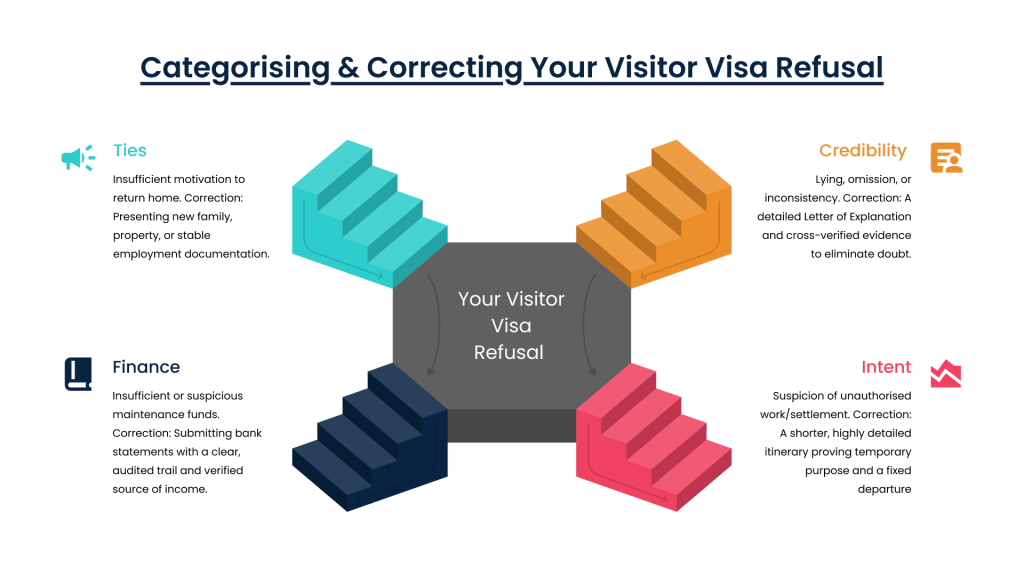
We immediately categorise the weakness to focus our strategy and gather only the necessary evidence.
| Refusal Category | UKVI Core Concern | JRI’s Legal Correction Focus |
| Ties | Insufficient motivation to return home | Presenting new family, property, or stable employment documentation established since the refusal. |
| Finance | Insufficient or suspicious maintenance funds | Submitting bank statements with a clear, audited trail and verified source of income. |
| Credibility | Lying, omission, or inconsistency | A detailed Letter of Explanation and cross-verified evidence to eliminate doubt. |
| Intent | Suspicion of unauthorised work/settlement | A shorter, highly detailed itinerary proving temporary purpose and a fixed departure. |
Preparing a Targeted Strategic Legal Submission

Simply re-submitting old documents is a guaranteed failure. A successful re-application demands a new legal argument.
- The Crucial Legal Letter of Explanation: Our solicitors draft a comprehensive legal letter that accompanies your new application. This document does not plead; it legally argues for procedural fairness and directly rebuts the ECO’s previous findings. We frame your submission to respect the legal process while clearly addressing the factual flaws in the original decision.
- Providing Compelling, Contemporary Evidence: You must present new, primary documents that were either absent or deemed insufficient in the first application. Examples: Documents showing the disposal of previous assets, a new lease agreement, or a letter from a new, reputable employer.
Step 2: Strategically Strengthening Your Application and Credibility
A successful re-application requires strategic action: you must actively demonstrate improved circumstances and provide compelling, new evidence. This section details the precise steps needed to address the refusal grounds and establish your strong bona fide applicant status and credibility with UKVI.
Overcoming Financial and Economic Deficiencies
If finance was the issue, your re-application must show demonstrable economic rootedness since the refusal.
- Demonstrating Economic Stability: Provide evidence of stabilized finances, such as a new, long-term employment contract, consistent monthly income, or proof of a recent, legitimate asset purchase. This proves improved financial standing.
- Transparently Sourcing Maintenance Funds: All funds must be transparently sourced. If a lump sum appeared recently, provide a legal explanation (e.g., sale of property, inheritance letter, detailed loan agreement). Show that your funds are clearly available to cover all expenses without relying on public funds.
Proving Genuine Intent and Strong Ties to the Home Country
You must convince the ECO that you are a genuine visitor who absolutely intends to return home.
- Documenting New, Compelling Ties: Evidence of compelling new ties established since the last refusal significantly counters the ECO’s doubt about your intent to leave.
- Examples of Compelling Ties:
- Marriage certificate or proof of a new dependent remaining home.
- Legal deeds for a significant new property purchase.
- Documentation of critical professional projects awaiting your return.
- The Necessity of a Cohesive and Detailed Travel Plan: Provide a concrete, detailed itinerary, including booked flights, confirmed accommodation, and a clear schedule of events. This establishes you as a bona fide applicant with a clear, temporary purpose.
JRI Solicitors’ Advantage: Essential Legal Expertise for High-Risk Cases
For applications carrying a refusal history, professional legal support is non-negotiable for mitigating risk and ensuring compliance with UK immigration law.
Why a Lawyer is Essential for a High-Risk Re-application
The stakes are simply too high to risk a DIY approach after failure.
- Mitigating Reputational Risk: A second refusal, particularly when the reasons mirror the first, dramatically lowers the chance of success for any future UK visa application. Our intervention demonstrates to the Home Office that you have sought professional remediation and are serious about compliance.
- Ensuring Technical Compliance: We understand the strict, technical evidentiary requirements of UKVI. We ensure every document is in the correct format, dated correctly, and legally translated, preventing the ECO from refusing your case on administrative grounds.
JRI’s Specialism in Challenging UKVI Decisions
JRI Solicitors is the specialist firm in Scotland that provides the high-level legal strategy complex re-applications demand.
- Our Solicitors possess deep knowledge of refusal jurisprudence and the specific Home Office casework criteria. We anticipate the ECO’s doubts before they arise and proactively address them in our submission.
- We advise you from our base in Glasgow, Scotland, ensuring our advice is current and specific to UK regulations.
Clarifying the Legal Terminology of Your Success
We empower you by clarifying the terms that define your success:
| Term | Meaning & JRI’s Role |
| Entry Clearance | The formal permission to enter the UK, which your visa grants. We aim to secure this. |
| On the Balance of Probabilities | The legal standard the ECO uses, they must be more than 50% sure you are not a genuine visitor. We structure your evidence to flip this probability. |
| Misrepresentation | Providing false information (or omissions), which leads to a 10-year ban. We ensure absolute compliance to avoid this. |
Act Now: Contact JRI Solicitors for Professional Review
Do not gamble with a second refusal. For a high-risk application, professional legal guidance is the necessary investment in your success.
Secure JRI Solicitors’ professional review and submission service in Glasgow.