

Securing a UK Spouse Visa for your partner is a vital step in your family life, but first, you must satisfy the financial test. The new £29,000 Minimum Income Requirement (MIR) poses a significant challenge if you do not meet the figure through salary alone.
The Home Office legally allows you to combine various funds from savings to pensions, but the precise rules for doing so are complex, unforgiving, and frequently lead to refusal if executed incorrectly.
At JRI, our expert lawyers master the compilation of complex financial evidence for Appendix FM applications. We understand the specific legal categories and the precise formulas required to combine funds legally. We demolish the risk of the financial test, protecting your application from refusal, and securing your family’s life together. Partner with JRI to prove your case with irrefutable confidence.
The Non-Negotiable Financial Test: Understanding the £29,000 Minimum Income Requirement (MIR)
The financial requirement is a statutory measure designed to ensure that couples can support themselves financially in the UK. JRI’s solicitors confirm that the information below is fully compliant with the latest UK Immigration Rules, specifically Appendix FM, which governs family visa applications.
Current MIR Rules (Post-April 2024): Precision is Key
The Minimum Income Requirement (MIR) is a non-discretionary rule. As of the recent changes (April 2024), the figure for the Sponsor is set at £29,000.
- The Active MIR: You must demonstrate a gross annual income of at least £29,000. This figure is the current starting point for all new applicants under the Family Route.
- The Simplification: Crucially, the requirement for an additional amount for the first child and subsequent children has been removed for all new applicants applying under this £29,000 threshold. The focus is solely on meeting the flat £29,000 figure.
Why This Requirement Exists: This financial threshold exists to guarantee that the family has no recourse to public funds, a legal term meaning they will not claim state benefits. Proving your financial stability is mandatory; failure to meet the MIR to the penny results in an automatic visa refusal.
Who Must Meet the Financial Requirement?
The responsibility for meeting the MIR usually falls on one or both partners, depending on their location and immigration status. Our solicitors clarify your specific obligations:
- The Sponsor’s Primary Responsibility: The income of the Sponsor (the UK citizen or settled person) is the primary source used to meet the MIR.
- When the Applicant’s Income Counts: The Applicant’s income can be included only if they are already in the UK with valid permission to work (e.g., switching from a Skilled Worker Visa or extending their existing Spouse Visa). If the Applicant is applying from overseas, their income cannot be included.
JRI’s Blueprint: Your Strategy for Combining Appendix FM Financial Categories
If your income from employment (Category A or B) falls below £29,000, you can combine it with other permitted sources. Our lawyers determine the most effective combination for your financial portfolio, often utilising three or four categories simultaneously.
Income Category Breakdown: The Permitted Sources
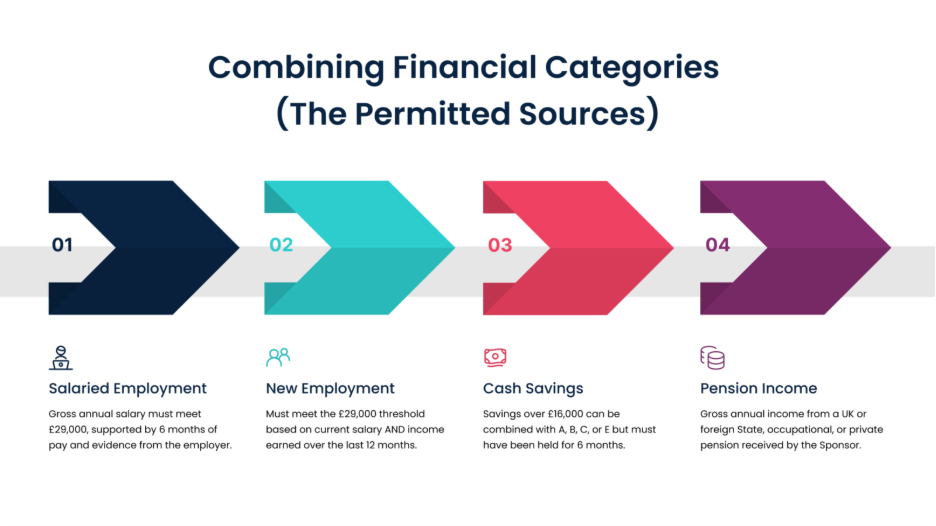
The rules define strict categories for sources of income. Our lawyers verify that your sources fall into these categories and that you provide evidence for the required period.
| Category | Source | JRI’s Key Compliance Rule |
| A | Salaried Employment (6+ months, same employer) | Gross annual salary at the date of application must meet the threshold, confirmed by 6 months of pay evidence. |
| B | Variable/New Employment (Less than 6 months, or variable) | Must meet the MIR both in terms of current annualised salary AND gross income earned over the last 12 months. |
| C | Non-Employment Income (Rental, Dividends, Interest) | Income must have been received consistently over the 12 months before the application. |
These categories D and E are often essential for meeting the £29,000 threshold but are subject to highly specific and unforgiving rules.
Category D: Cash Savings and the Exact Calculation Formula
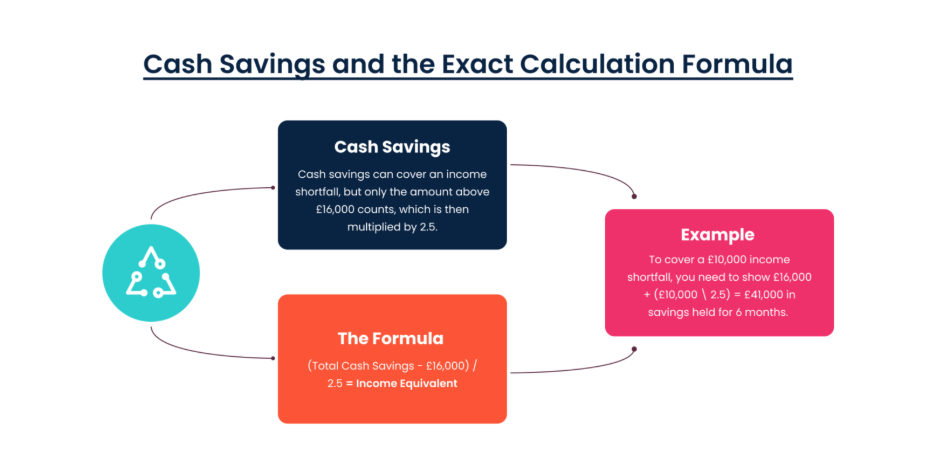
You can rely on Cash Savings above £16,000 (held by the sponsor, applicant, or both jointly) to cover the shortfall. This is the most public area of error without legal oversight.
Category E: Pension Income
Pension income is a valuable, secure source of funds that can be combined with employment income and savings.
- You can count the gross annual income from any UK State, occupational, or private pension received by the Sponsor (or Applicant, if applicable).
- The pension must have become a source of income at least 28 days prior to the date of application, and proof of receipt is essential.
Avoiding Refusal: The Evidential Requirements for Each Source
Meeting the financial threshold is only half the battle; proving it correctly with Specified Documents is where JRI guarantees success. Complex combinations of funds frequently fail due to documentation errors, not a lack of funds.
The Fatal Flaw: Understanding Incompatible Categories and the Six-Month Rule

The Home Office imposes strict Evidential Requirements. Failing to meet the documentation standard for any sole source leads to the rejection of the entire financial evidence.
- The Six-Month Holding Rule: Savings must have been held in the account for at least six continuous months prior to the date of application. If funds were transferred from a liquidated asset (like property or shares), you must show clear legal documentation proving the source of the funds.
- Incompatible Categories: You cannot combine Category D (Cash Savings) with Categories F or G (Self-Employment or Specified Limited Company Income). JRI ensures your selected categories are legally combinable before compiling the application.
The JRI Documentation Review and Submission

Our comprehensive service is designed to eliminate the risks associated with multi-source evidence, acting as a final, critical checkpoint for your application.
- Compiling the Legal Submission Letter and Financial Audit: We prepare a detailed Legal Submission Letter which includes a clear financial audit. This letter summarizes exactly how the £29,000 MIR is met, cross-referencing every pay slip, bank statement, and savings calculation to the relevant paragraph in Appendix FM.
- Pre-Submission Vetting: We conduct a final, rigorous vetting process, checking that all bank statements are on letterhead; all employment letters are dated correctly, and the cash savings calculation is exact. This process guarantees your submission is compliant and significantly speeds up the caseworker’s decision, reflecting the professionalism of a leading Glasgow firm.
Secure Your Family Life with JRI Solicitors
The new £29,000 Minimum Income Requirement is a reality, but it should not prevent your family from being together in the UK. By strategically combining income, savings, and pensions, you can meet the financial test.
JRI Solicitors provides the expert legal planning, precise calculation, and guaranteed documentation review you need to navigate this hurdle successfully. We remove the risk of refusal from complex financial arrangements, securing your family’s Leave to Remain in Scotland.
Act Now: Consult a JRI Immigration Solicitor Today
Do not let the complexity of Appendix FM threaten your family’s future. The financial stakes are too high for mistakes.
Call JRI Solicitors now or visit our Glasgow offices to book a priority financial consultation.
Choose JRI Solicitors: We are your dedicated legal experts, ensuring your complex financial circumstances translate into a clear, successful visa application. Start securing your family life today.