
Receiving a UK Student Visa Refusal is profoundly disheartening, but a refusal based on a perceived lack of Genuine Intention or credibility is the most critical hurdle. This specific decision, citing a failure of the Genuine Student (GS) requirement, suggests the Home Office caseworker believes your true purpose is not academic. This severe judgment is difficult, but not impossible, to reverse.
At JRI Solicitors, our expert immigration lawyers specialise in Challenging and Vigorously Rebutting these high-risk credibility decisions. We deconstruct your refusal letter to pinpoint the caseworker’s precise concerns. We then construct a robust legal strategy, preparing either a limited Administrative Review (AR) or a strategic Re-application with compelling new evidence. Don’t let a negative credibility judgment end your UK educational ambitions partner with JRI to overturn the decision today.
Understanding the Refusal: What the Genuine Student (GS) Requirement Demands
The Genuine Student (GS) requirement is a mandatory, non-discretionary test every Student Visa applicant must pass under the UK Immigration Rules. It is a critical assessment of your honesty, academic progression, and future. Failure to satisfy the caseworker on the GS requirement is absolute grounds for refusal. Our lawyers ensure you fully grasp the gravity of this test and the specific legal reasons behind your refusal.
The GS Legal Basis: Understanding the ‘Balance of Probabilities’
The GS requirement falls under Appendix Student of the Immigration Rules. It mandates that the applicant must genuinely intend to study their chosen course in the UK. This test is subjective and is where the expertise of JRI Solicitors proves invaluable, as we argue intent using legal precedent. The caseworker must assess your intent based on the Balance of Probabilities. This legal jargon means they only need to be more likely than not persuaded that you are not a genuine student.
- The Subjective Test: Caseworkers assess the application as a whole, scrutinising the course’s relevance to your past study or career, your academic progression, and your post-study intentions.
- The Burden of Proof: You bear the heavy burden of proving your genuine intent. JRI’s lawyers provide the compelling, documented arguments necessary to meet this high standard.
- Legal Standard: The caseworker must be persuaded on the Balance of Probabilities, meaning they only need to be more likely than not persuaded that you are not a genuine student for a refusal to stand.
The Caseworker’s Focus: Assessing Intent and Credibility

The caseworker’s main tool for assessing credibility is the Credibility Interview. They forensically scrutinise several key areas for inconsistencies between your application, your interview answers, and the documents provided.
| Area of Caseworker Scrutiny | Key Question for the Applicant |
| Academic Coherence | Does your chosen course logically follow your previous education/career? |
| Economic Justification | Does the cost of the course make sense relative to your home country’s economy and your potential post-study salary? |
| Sponsor Knowledge | Do you demonstrate adequate knowledge of the course, modules, and the institution (your sponsor)? |
Common Grounds for GS Refusal (The Credibility Checklist)
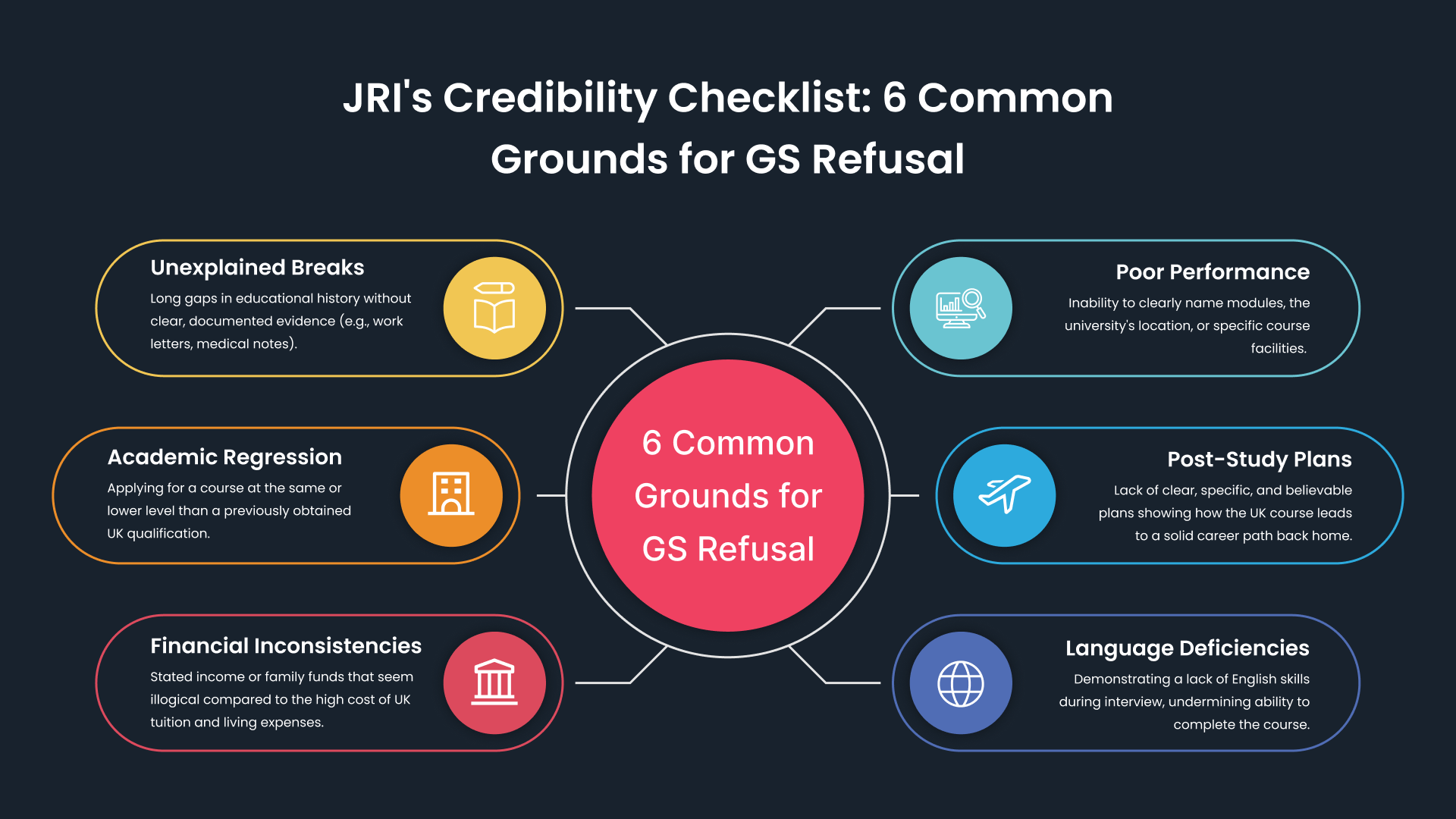
Credibility refusals rarely happen in isolation; they stem from a combination of red flags the caseworker identifies. We list the most frequent areas of failure our JRI lawyers address in re-applications:
- Financial and Educational History Gaps:
- Unexplained Breaks: Significant, long gaps in your educational history without clear, documented reasons (e.g., medical certificates, work experience letters).
- Academic Regression: Applying for a course at the same or a lower academic level than a previous UK qualification (Academic Progression failure).
- Financial Inconsistencies: Stated family income or career progression that is illogical when compared to the high cost of UK tuition and living expenses.
- Failure to Demonstrate Course and UK Knowledge:
- Poor Interview Performance: Inability to name the course modules, final qualification, or explain the university’s location and specific facilities during the interview.
- Vague Post-Study Plans: Lack of clear, believable plans for returning home or working after the course, failing to show precisely how the UK course relates to a clear career path.
- Language Deficiencies: Although not a direct GS failure, demonstrating a lack of necessary English skills during the interview severely undermines your ability to complete the course, thus calling your genuine intent into question.
The Long-Term Impact: Why a GS Refusal Marks Your Immigration Record
A refusal based on credibility carries a severe stigma that impacts all future UK visa applications. The decision is logged and can be referenced by caseworkers for years. This demands expert counsel, not simply a DIY response.
- Heightened Scrutiny: Any subsequent application will face significantly higher scrutiny, making a successful Re-application without expert legal help highly unlikely.
- Long-Term Impact: This specific refusal type can negatively impact applications for other routes (like the Skilled Worker visa) if the underlying integrity issue is not properly addressed and legally explained.
JRI’s Immediate Legal Strategy: Deconstructing the Refusal Letter

JRI’s first step is a forensic review of the refusal letter. This letter is the blueprint for our strategy, detailing the caseworker’s precise reasons for doubt.
- Targeted Analysis: We pinpoint whether the refusal was based on a factual error (Case working Error) or a subjective judgment (Credibility Failure).
- Strategic Direction: This analysis dictates our immediate next step: pursuing a limited Administrative Review (AR) or undertaking a comprehensive, new Strategic Re-application. We do not waste your time or money on the wrong legal path.
Your Post-Refusal Strategy: Administrative Review or Re-application?
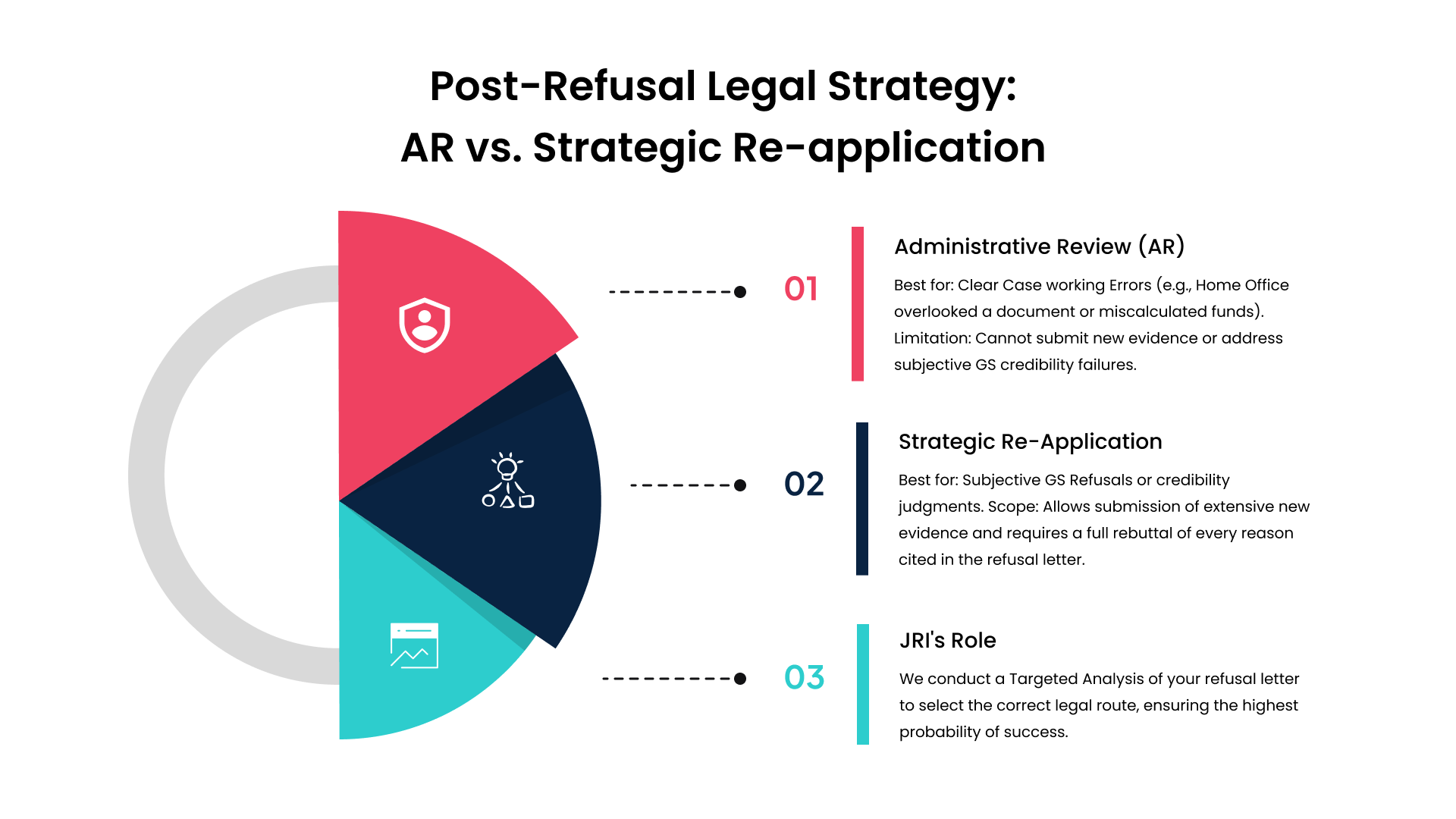
When faced with the shock of a Visa Refusal, immediate and correct legal action is paramount. The two primary legal routes forward are the Administrative Review (AR) and a Strategic Reapplication. Our lawyers assess your refusal letter against current UK Immigration Rules to recommend the most viable path. We weigh the potential time saved by AR against the superior evidential scope offered by a re-application, ensuring we choose the strategy with the highest probability of success for your unique case.
Option 1: Administrative Review (AR)
Administrative Review is a request to the Home Office to check the refusal decision for a procedural or factual error. This is a very limited remedy, suitable only for challenging a clear Case working Error. You cannot submit extensive new evidence to address core credibility concerns.
- When AR is Applicable: AR is only appropriate if the caseworker made a verifiable mistake (e.g., they overlooked a document you clearly provided, miscalculated your maintenance funds, or applied the wrong version of the rules).
- Strict Time Limit: You usually have only 14 days to apply for an AR from the date you receive the refusal notice.
- Crucial Limitation: You cannot submit new evidence. If the refusal was based on your interview answers or subjective judgment, AR is not the correct strategy.
Option 2: The Strategically Sound Re-application
For refusals based on the subjective Genuine Student (GS) requirement or a perceived lack of credibility, Strategic Re-application is often the only viable legal route. JRI’s lawyers recommend this path because it allows us to submit extensive new evidence and directly rebut every point of the caseworker’s judgment.
Addressing the Refusal Reasons Directly (The Substantive Change Requirement)
A successful re-application requires demonstrating Substantive Change—you must show that you have fully overcome the specific reasons cited in the refusal letter.
- JRI’s Method: We compile a comprehensive legal submission that directly rebuts each refusal point.
- Evidence Remediation: If the refusal cited unclear post-study plans, we help you draft a detailed, plausible career progression document. If it cited financial inconsistencies, we secure new financial evidence that is impeccable and fully sourced.
- Securing a New CAS: A new application requires a new Confirmation of Acceptance for Studies (CAS) from your university. We liaise with your sponsor to confirm their continued support, which is crucial after a GS refusal.
JRI’s Winning Strategy: Overcoming Credibility Challenges
Our ability to overturn complex GS refusals stems from our experience and legal precision. We don’t just fill out forms; we build an air-tight legal case designed to convince the caseworker of your genuine intent. We provide practical, targeted support to prepare you for the inevitable scrutiny of a subsequent application.
If the Home Office requests a second interview, our preparation is invaluable. This preparation is non-negotiable for success.
- Mock Interviews: JRI lawyers conduct realistic mock interviews, training you to answer questions clearly, confidently, and consistently with your application documents.
- Strategic Talking Points: We help you articulate the coherence of your study plan and the economic sense of your investment in UK education. We ensure your answers align perfectly with the documents we submit.
Guaranteeing Financial and Academic Coherence
We ensure all elements of your application tell a single, persuasive story.
- Academic Alignment: We submit letters from previous employers or academic advisors to vouch for your professional trajectory, verifying that the course rationale perfectly aligns with your career goals.
- Financial Integrity: We ensure your financial documents align with the maintenance requirements and that the source of funds is clearly explained, eliminating any suggestion of improper ‘fund parking.’
The JRI Advantage: Applying Legal Jargon and Precedent
Our expertise is demonstrated by our comprehensive legal submissions, which speak the language of the Home Office and the courts.
- Legal Authority: When the caseworker’s decision appears flawed or subjective, our lawyers cite relevant UK Case Law (legal precedents) to argue why the refusal decision is legally unsound or disproportionate.
- Professional Submission: We compile a submission that far exceeds the minimum evidential requirements, including a detailed, paginated index of documents and a clear legal submission letter. This professional presentation maximises your chance of a positive decision.
Immediate Action Required: Unsure if you qualify for an Administrative Review or need a Strategic Re-Application? Let JRI Solicitors Analyse Your Refusal Now.
Consult a JRI Immigration Solicitor Today: Don’t waste critical time attempting to decipher the legal jargon or strategy on your own.
Choose JRI Solicitors: We start securing your new application immediately. Call us now or book your priority consultation online. Take the definitive step toward securing your UK visa success today.