Reuniting with your family is a priority, but the legal landscape for entering the UK is rigid. If you are a British citizen or a settled person living in Glasgow, you likely feel the weight of the strict 2026 Home Office requirements. At JRI, we see the stress that shifting income thresholds and digital visa changes cause. Our expert lawyers specialise in providing the clarity and confidence you need to bring your partner and children home. By focusing on the specific legal standards of Appendix FM, we ensure your family’s future in Scotland is built on a solid foundation.
Establishing Eligibility under Appendix FM
The primary route for family migration is found in Appendix FM of the Immigration Rules. This section sets the standard for how the UK balances the right to family life with immigration control. To sponsor a family member, you must generally be a British or Irish citizen, hold Indefinite Leave to Remain (ILR), or have settled status under the EU Settlement Scheme (EUSS).
Qualifying as a Partner: Spouses, Civil Partners, and Unmarried Couples
To apply as a partner, you must be in a marriage or civil partnership recognised in the UK. For those who are not married, the Home Office requires proof of a Durable Relationship.
- Marriage/Civil Partnership: You must provide a valid certificate and prove you have met in person.
- Unmarried Partners: In 2026, this usually means showing you have lived together for at least two years. However, the rules allow for flexibility if you have a significant shared life but were unable to live together due to work, study, or cultural reasons.
Requirements for Dependent Children under 18
Your children can join you if they are under 18 at the time of application. They must not be leading an Independent Life, which means they must still rely on you for financial and emotional support and must not be married or have formed their own family unit.
Proving Sole Responsibility and Serious Considerations
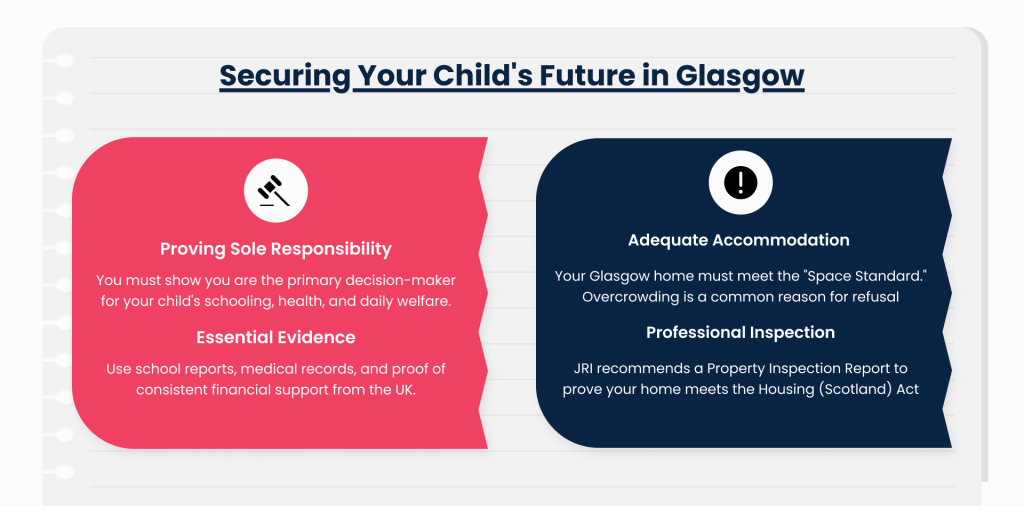
If only one parent is moving to the UK, you must demonstrate Sole Responsibility for the child’s upbringing. This is a high legal bar. You must show you have had total control over the child’s daily life and major decisions, such as schooling and medical care.
If you cannot prove this, our solicitors at JRI help you argue Serious and Compelling Family Considerations. This legal argument ensures the child’s best interests are prioritised, making their exclusion from the UK undesirable.
Meeting the 2026 Financial Requirement
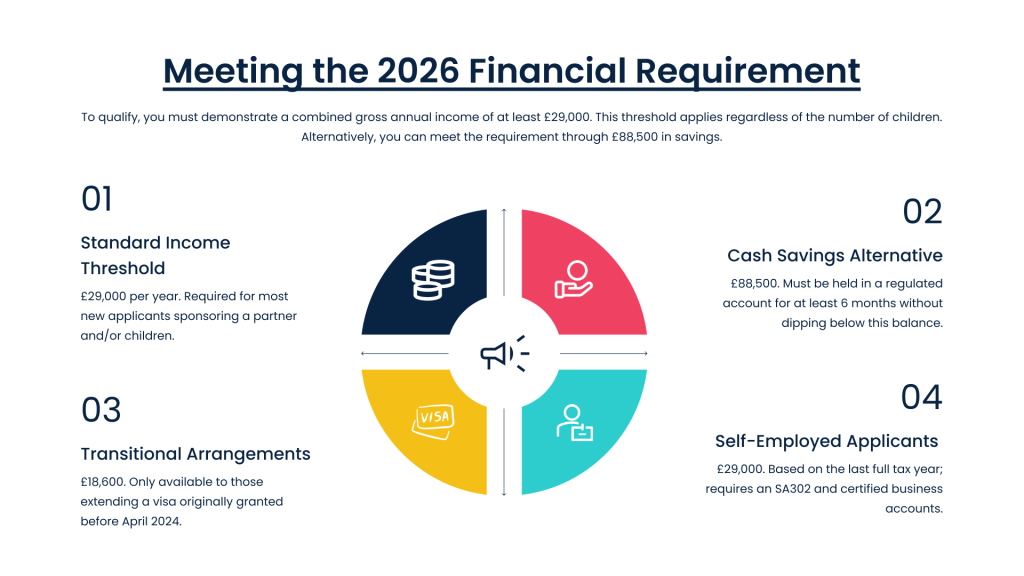
The most significant hurdle for many Glasgow families is the Minimum Income Requirement (MIR). The Home Office enforces this strictly to ensure families do not rely on Public Funds.
The £29,000 Threshold: Income, Savings, and Exemptions
As of January 2026, the standard gross annual income required to sponsor a partner is £29,000. Unlike previous years, there is no longer a separate “child component” added to this headline figure for most new applicants. You can meet this through salaried work, self-employment, or a pension.
| Financial Source | Minimum Requirement | Key Evidence Needed |
| Salaried Employment | £29,000 per year | 6 months of payslips & bank statements |
| Cash Savings Only | £88,500 | Held for at least 6 months |
| Self-Employment | £29,000 (Last tax year) | SA302 and certified accounts |
Transitional Rules: Are You Eligible for the Lower £18,600 Rate?
If you applied for your first partner visa before April 11, 2024, and are now extending your stay with the same partner, you fall under Transitional Arrangements. This allows you to remain on the older £18,600 threshold (plus child components). JRI’s lawyers check your immigration history to ensure you are not held to a higher financial standard than necessary.
Feeling overwhelmed by the £29,000 requirement?
[Contact JRI Glasgow Today for a Consultation]
Proving Your Relationship and Life in Glasgow
The Home Office does not take your word for it; they require Specified Evidence. Every document must meet the exact format required by the rules to avoid a rejection.
Evidencing a Genuine and Subsisting Relationship
You must prove your relationship is Genuine and Subsisting. This involves more than just a marriage certificate. We help you compile a “timeline of life” including:
- Joint Financial Commitments: Such as joint bank statements, utility bills, or insurance policies.
- Shared Responsibility: Evidence of caring for children or shared household costs.
- Regular Communication: Logs of messages, video calls, or travel tickets during periods of separation.
Adequate Accommodation Standards in Scotland
You must have Adequate Accommodation for your family. In Glasgow, this means your home must not be Statutorily Overcrowded under the Housing (Scotland) Act.
- The Room Standard: People of opposite sexes (who are not a couple) should not have to sleep in the same room if they are over 10 years old.
- The Space Standard: The number of people allowed depends on the number of rooms and their floor area.
JRI often recommends a Property Inspection Report for tenement flats or shared homes. This professional report confirms you have enough rooms for everyone and that the property meets public health regulations.
The Step-by-Step Application Process
The application is now almost entirely digital, following the UK’s move toward a Digital-First immigration system in early 2026.
From Online Submission to the Digital eVisa
- Online Submission: Complete the forms on the Gov.uk portal and pay the Immigration Health Surcharge (IHS). This fee grants your family access to the NHS in Scotland.
- Biometrics: Your family will attend an appointment at a Visa Application Centre to provide fingerprints and a photo.
- Document Upload: All evidence must be scanned and uploaded to the portal.
- The eVisa: As of January 2026, successful applicants receive an eVisa rather than a physical card. This digital record is linked to their passport and can be shared with employers or landlords via a “share code.”
Why JRI Solicitors are the Trusted Choice for Glasgow Families
The legal standards for partner and child visas are strict, and the consequences of a refusal are high. JRI is a visible leader in the Glasgow legal community because our solicitors provide more than just advice; we provide results.
Our expert lawyers specialise in Forensic Case Preparation. We don’t just “check” your documents; we audit them for any potential flags that a Home Office caseworker might use to refuse you. We understand the nuances of Scottish Property Law and the specific challenges of the 2026 eVisa system.
From the initial Eligibility Assessment to the final Legal Representation Letter that accompanies your application, JRI is on hand to advocate for your family. We represent diverse families with pride, ensuring that your right to a shared life in Scotland is protected.