For business professionals in Glasgow, the ability to move seamlessly through the Schengen Area is vital for international trade, contract negotiations, and commercial expansion. However, as we move through 2026, the European Union has fully implemented digital border reforms that fundamentally change how visa validity is monitored. While the core “90-day” rule remains the legal standard, the transition from manual passport stamps to the Entry/Exit System (EES) means that every hour you spend in the zone is now tracked with biometric precision.
At JRI, our expert solicitors in Glasgow deliver the clarity and confidence you need to manage cross-border interests. We understand that “business as usual” starts with a rock-solid travel strategy. This guide breaks down the essential legal pathways, ensuring your professional presence in Europe remains compliant and uninterrupted.
Validity Period vs. Duration of Stay: Clearing the Legal Confusion
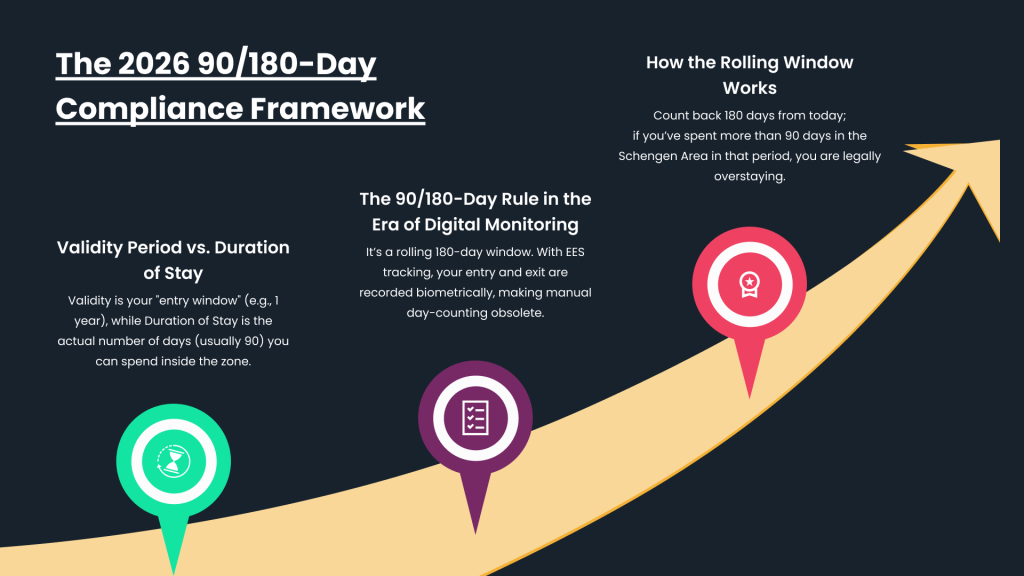
When you receive a Schengen business visa (Type C), two specific figures define your travel rights. Our lawyers at JRI often see clients confuse these terms, which leads to “overstaying”—a violation that now triggers an automatic digital alert across 29 European countries.
1. The Validity Period (The “Window”)
The validity period is the timeframe during which your visa is active. For example, a “One-Year Multiple-Entry Visa” has a validity of 365 days.
- Entrance Rights: You can enter the Schengen Area at any point between the “From” and “Until” dates printed on your visa sticker or digital record.
- Expiration: Once the “Until” date passes, your visa is void, even if you have unused days left in your allowance.
2. The Duration of Stay (The “Days”)
The duration of stay is the actual number of days you are permitted to remain inside the Schengen territory.
- Standard Limit: For short-stay business visas, this is typically capped at 90 days.
- Cumulative Count: These days are cumulative across all 29 member states. If you spend 10 days in Paris and 5 days in Berlin, you have used 15 days of your duration.
3. Understanding Single vs. Multiple Entry
The nature of your business trip often dictates which visa you are granted. At JRI, we advocate for the highest level of entry for our clients to ensure maximum flexibility:
- Single-Entry (01): Valid for one entry only. Even if your duration says “30 days” and you leave after 2 days, the visa is exhausted.
- Multiple-Entry (MULT): The gold standard for Glasgow entrepreneurs. It allows you to enter and exit as required, provided you respect the overall stay limits.
The 90/180-Day Rule in the Era of Digital Monitoring
The “short-stay” limit is legally defined as 90 days within any 180-day period. This is a “rolling” window, meaning it looks backward from every single day you are present in the zone.
How the Rolling Window Works
To calculate your compliance, you must count back 180 days from the current date. If the total number of days spent in the Schengen Area during that half-year period exceeds 90, you are in breach of immigration law.
2026 Regulatory Update: In previous years, travellers relied on manual passport stamps. However, since the full rollout of the Entry/Exit System (EES), the European Union now uses facial recognition and fingerprints to calculate your 90-day allowance in real-time.
Secure Your Professional Reputation: In 2026, the EES instantly identifies overstays, which can lead to immediate entry bans. Our solicitors at JRI provide professional 90-day audits to ensure your travel history remains impeccable.
2026 Digital Border Reforms: The Impact of EES and ETIAS
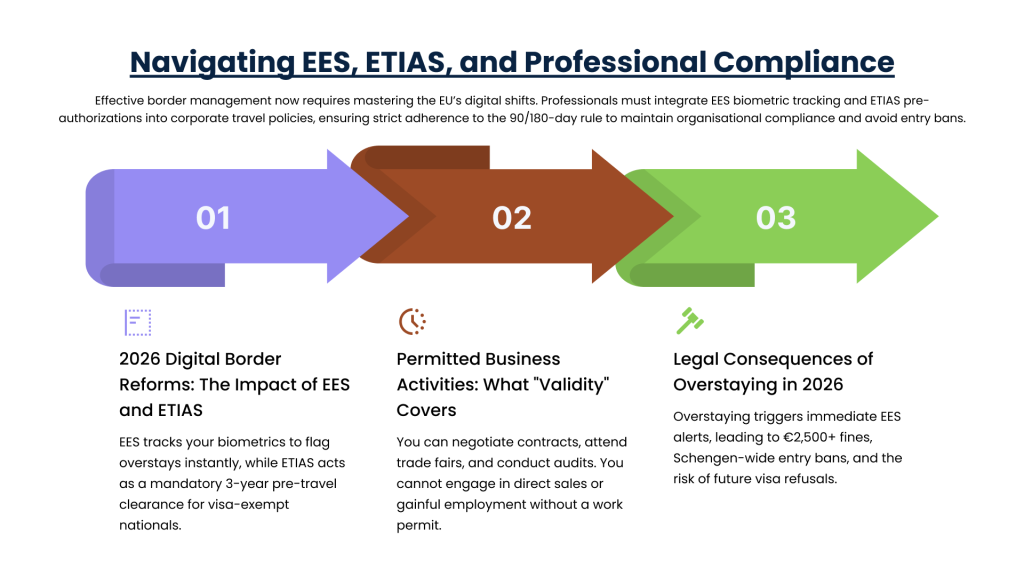
As we navigate 2026, two major systems now govern your presence in Europe. These do not replace visas, but they act as the “digital gatekeepers” of your validity.
The Entry/Exit System (EES)
The EES replaces manual stamping with a digital file.
- Biometric Registration: On your first entry in 2026, you must provide fingerprints and a facial scan.
- Automatic Overstay Flagging: If you stay for 91 days, the system generates an “Overstay Alert” visible to all member states.
- Data Retention: Compliant travel data is stored for 3 years; overstay records are kept for 5 years, directly impacting your ability to get future visas.
The ETIAS Requirement (2026 Implementation)
For British citizens and other visa-exempt nationals, the ETIAS (European Travel Information and Authorisation System) is the new mandatory pre-travel clearance.
- Validity: Typically valid for 3 years or until your passport expires.
- Scope: Covers 30 European countries. Note that ETIAS does not grant you more days; it simply authorises you to use the standard 90/180-day allowance.
| System | Primary Function | Cost | Impact on Validity |
| EES | Tracks entries/exits via biometrics | Free | Identifies overstays instantly |
| ETIAS | Pre-travel security screening | €7 | Linked to your 90/180-day limit |
| Schengen Visa | Authorisation for non-exempt nationals | €90 | Strictly limited by sticker dates |
Permitted Business Activities: What “Validity” Covers
It is a common legal mistake to assume a “Business Visa” allows you to work. In 2026, European authorities distinguish strictly between “Business” and “Productive Labour.” Our lawyers ensure you never inadvertently breach these conditions.
What You CAN Do on a Business Visa:
- Negotiation: Attending meetings, pitch sessions, or signing commercial contracts.
- Networking: Participating in trade fairs, exhibitions, or professional seminars.
- Auditing: Conducting site visits or inspections for your Glasgow firm.
- Strategic Planning: Attending internal company board meetings or retreats.
What You CANNOT Do (Without a Work Permit):
- Direct Sales: Selling goods or services directly to the public.
- Gainful Employment: Being paid by a company based within the Schengen Area.
- Technical Support: Providing on-site maintenance or repair services (unless specifically exempt).
Legal Consequences of Overstaying in 2026
The automated nature of 2026 border controls means overstaying is no longer a “grey area.” It is identified the moment you scan your passport at the exit gate.
- Administrative Fines: These are no longer discretionary. In countries like Germany or Spain, fines for overstaying even by a few days can exceed €2,500.
- SIS (Schengen Information System) Alerts: Your biometric data is flagged across the entire zone. This “alert” makes it nearly impossible to enter any other Schengen country.
- Entry Bans: A significant overstay can result in a 1 to 5-year ban from all Schengen member states.
- Visa Refusals: Once you have a “History of Non-Compliance” in the EES, securing any future UK, US, or EU visa becomes significantly more difficult.
How JRI’s Glasgow Solicitors Support Your Business Mobility
The 2026 immigration landscape is designed for efficiency, but it creates a minefield for the unprepared. At JRI, our solicitors act as your legal shield, ensuring your professional life is never sidelined by a border dispute.
Our Expertise Includes:
- Validity Maximisation: We assist frequent travellers in Glasgow to build a case for 5-Year Multiple-Entry Visas, saving you the stress of constant renewals.
- Digital Compliance Audits: We use current 2026 EES logic to verify your rolling 90-day window before you fly, preventing accidental overstays.
- Complex Case Resolution: If you have been wrongly flagged by the EES or issued an entry ban, we provide the robust advocacy needed to clear your name.
- Business Document Vetting: We oversee the drafting of Business Invitation Letters to ensure they meet the specific, stringent requirements of Schengen consulates.