When the Home Office refuses your visa and confirms you have no right of appeal, you face a critical legal deadline. The situation is even more challenging when the refusal notice states you have no statutory right of appeal. This often leaves applicants feeling that their journey has ended.
A refusal is rarely the outcome. Expert immigration lawyers offer the clarity and confidence required to contest an unfair or unlawful decision. The key is finding the correct legal path for your challenge, ensuring your case receives the thorough consideration it deserves under UK law.
The Restricted Right to Appeal: Understanding the Legal Shift

The Immigration Act 2014 significantly restricted the ability to challenge a negative Home Office decision and heavily reduced the automatic right to appeal. Now, many decisions must be challenged through specific, alternative mechanisms. Knowing the correct mechanism for your refusal is the first crucial step.
Key Situations Where the Appeal Right is Absent
Not every refusal gives you an automatic right to go before the First-tier Tribunal (Immigration and Asylum Chamber).
- Certification: The Home Office might certify a claim (often relating to protection or human rights) as “clearly unfounded.” This prevents immediate appeal within the UK.
- Out-of-Country Applications: Many refusals for visas applied outside the UK (out-of-country applications) do not include an appeal right. They may instead qualify for an Administrative Review.
- Points-Based System: Entry clearance applications (out-of-country) for the PBS often have no appeal, while in-country refusals are subject to AR.
What is the Statutory Right of Appeal?
A statutory right of appeal is a right the law grants directly to challenge a decision before an independent body. Today, these appeals are generally limited to decisions where the refusal breaches your human rights under Articles 3 or 8 of the European Convention on Human Rights or protection claims. If your refusal does not involve these specific grounds, we must look beyond the appeal system to other remedies like Judicial Review.
Do not wait. Seek immediate legal advice upon receiving your refusal notice.
The Primary Alternative: Administrative Review
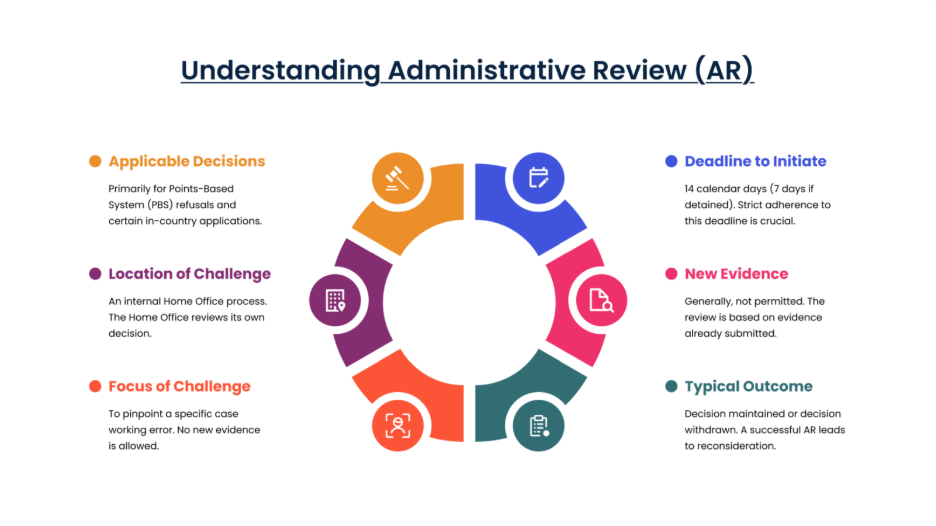
If your refusal is based on the Points Based System (e.g., Skilled Worker, Student), the Home Office usually grants the option of Administrative Review (AR). This is an internal check where the Home Office reviews its own decision.
Eligibility and Scope of Administrative Review (AR)
Administrative Review is a formal process. You ask the Home Office to check if they made a case working error when processing your application.
- What is AR? It is available for specific categories, including most Skilled Worker, Student, and certain in-country Spouse/Partner visa refusals.
- What You Can Challenge: You cannot submit new evidence or change your application. The review must focus strictly on established errors:
- The decision-maker failed to apply the Immigration Rules correctly.
- The decision-maker did not follow proper procedures.
- The decision-maker made a mistake in calculating your points or eligibility.
The AR Process and Outcomes
The Administrative Review requires precision and strict adherence to deadlines, usually handled via the online AR-1 form.
- Application: Submit the AR request promptly, clearly stating the precise error you are challenging.
- Fee: Pay the required fee (unless waived).
- Outcome: The Home Office generally aims to decide within 28 days.
- Decision Maintained: If they find no error, the original refusal stands.
- Decision Withdrawn: If a case working error is identified, the refusal is cancelled, and your application is re-considered.
Careful drafting of this submission is crucial. The key is to pinpoint the exact error and cite the relevant legal guidance to maximise the chance of a successful outcome.
Judicial Review (JR): The Fundamental Challenge to Lawfulness
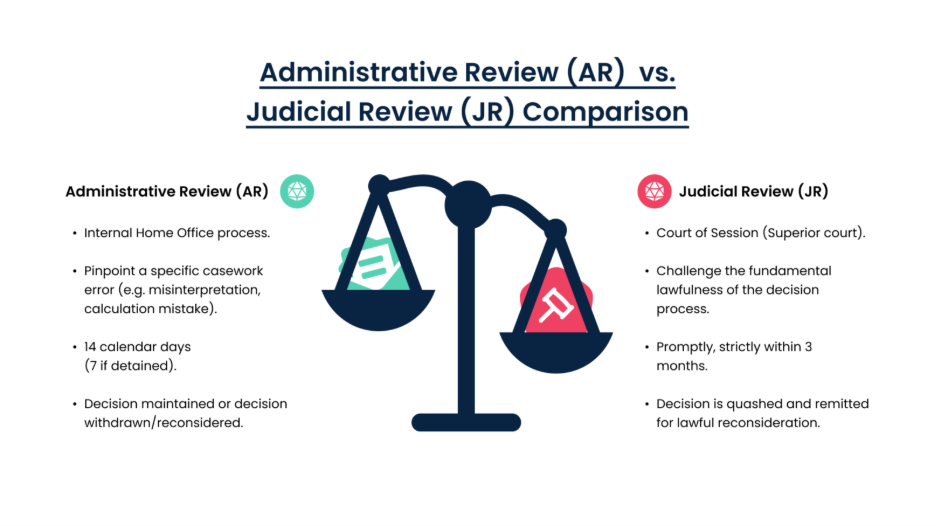
When no appeal right exists, and Administrative Review is unavailable or fails, your most powerful legal option is Judicial Review (JR). JR is not about deciding the application’s merits; it is a fundamental challenge to the lawfulness of the Home Office’s decision-making process.
| Feature | Administrative Review (AR) | Judicial Review (JR) |
| Applicable Decisions | Points-Based System (PBS) refusals and certain other in-country applications. | Any decision where no statutory appeal or AR is available/successful. |
| Location of Challenge | Internal Home Office process. | Court of Session (Superior court in Scotland). |
| Focus of Challenge | To pinpoint a specific case of working error (legal, procedural, or calculation mistake). | To challenge the fundamental lawfulness of the decision-making process. |
| Deadline to Initiate | 14 calendar days (7 days if detained). Crucial. | Promptly, and strictly within 3 months. |
| New Evidence | Generally, not permitted. The review is based on evidence already submitted. | Only relevant to show the decision-maker failed to consider it (procedural impropriety). |
| Typical Outcome | Decision maintained or decision withdrawn/reconsidered. | The decision is quashed (nullified) and remitted to the Home Office for lawful reconsideration. |
The Grounds for Seeking Judicial Review

The superior court hears JR challenges. It challenges how the decision was made, based on three core legal principles:
- Illegality: The decision-maker acted outside the legal powers given to them by Parliament. This legally constitutes an error of law.
- Irrationality: The decision must be so unreasonable that no sensible public body would make it manifestly irrational.
- Procedural Impropriety: The decision-maker failed to follow fair and proper procedures.
The Judicial Review Process in Scotland
The process for JR is highly technical. In Scotland, these actions are brought in the Court of Session in Edinburgh.
- Pre-Action Protocol (PAP): This is a mandatory first step. We send a formal Letter Before Action to the Home Office. This outlines our legal grounds and demands they reconsider the decision before court action begins.
- Petition and Leave to Apply: If the Home Office response is unsatisfactory, we lodge a petition. We must first get Leave to Apply (permission) from the court. The judge must be satisfied that the case has sufficient merit.
- Full Hearing: If permission is granted, a full court hearing takes place to present the legal arguments.
Case Law Precedents
Successfully bringing a Judicial Review requires citing established precedents and case law. We must show that the Home Office either failed to consider relevant consideration or considered an irrelevant consideration. This technical failing constitutes an error of law and forms a key basis for a successful JR challenge.
Beyond Formal Challenge: Strategic Avenues for Recourse
Beyond the formal AR and JR mechanisms, other strategic routes might be available to challenge a refusal.
Fresh Claims and Submissions
If you have new, compelling evidence that was unavailable at the time of the original decision, you may be able to submit a Fresh Claim (or further representations.
- Key Criterion: The new evidence must be significantly different from the original material. It must create a realistic prospect of success. The failure to consider this new material would need to amount to a breach of human rights or the Refugee Convention.
- Strategic Submissions: For discretionary decisions, our expert lawyers prepare persuasive submissions, supported by new evidence, to encourage the Home Office to re-examine the case outside formal challenge processes.
The Role of MP and Parliamentary Oversight
While a Member of Parliament (MP) cannot legally overturn a decision, they can make humanitarian submissions to the Home Office. We use this in cases where strong factors exist that may not fit neatly into the Immigration Rules. Though political, this oversight can sometimes lead to discretionary reconsideration
Securing Your Future with JRI Solicitors, Glasgow
The lack of an appeal right means your situation is highly specialised and legally intricate. You need lawyers who can swiftly assess your refusal and apply the exact legal strategy required, whether it’s Administrative Review or the rigorous demands of Judicial Review.
Why Expert Legal Counsel is Crucial?
Challenging a decision without an appeal is fundamentally about legal compliance and procedure. A simple mistake missing a deadline, incorrectly identifying the legal ground for JR, or failing to articulate the error in an AR can permanently jeopardise your ability to remain in the UK.
- We Guide Your Strategy: Our expertise is in quickly diagnosing the refusal to determine the correct legal path: AR, JR, or a Fresh Claim.
- We Enforce Deadlines: We ensure immediate action is taken to comply with the tight deadlines for both AR and JR, where promptness is a legal necessity.
JRI’s Expertise in Challenging Home Office Decisions
JRI Solicitors is a trusted law firm with specialised knowledge in UK Immigration Law and the Court of Session procedures specific to Scotland.
Our Glasgow-based solicitors:
- Possess deep, current knowledge of all relevant statutes, secondary legislation, and Immigration Rules.
- Are experts at drafting detailed Administrative Review submissions, focusing on clear case working errors.
- Regularly handle the entire Judicial Review process, from the mandatory Pre-Action Protocol to obtaining Leave to Apply.
- We provide clear, accessible legal counsel. We include all clients and fully empower them through a clear understanding of their legal rights.
Connect with Our Legal Team Today
If the Home Office has refused your application without a right of appeal, you face a significant legal hurdle. JRI Solicitors provides the authoritative legal support you need to challenge that decision effectively. We will apply our specialised knowledge to protect your rights and your future in the UK.
Don’t let a refusal be the final word. Contact our expert lawyers in Glasgow today for an immediate, confidential consultation.
| Action Required | Timeline | Obligatory |
| Administrative Review | Within 14 Days of Refusal | Call JRI Solicitors |
| Judicial Review | Within 3 Months | Email us your Refusal Letter |
| General Consultation | For Strategic Advice and Fresh Claims | Visit |