
The desire to blend professional obligations with personal leisure often termed “bleisure” travel is a significant trend for the international community in Scotland. If you hold a Uniform Schengen Visa (Type C) issued for tourism, you may wonder if you can legally transition from a holiday in the French Riviera to a board meeting in Paris.
The Uniform Schengen Visa (Type C): One Permit, Multiple Purposes
A frequent misconception our lawyers encounter is that a “Business Visa” and a “Tourist Visa” are entirely distinct entities. In legal reality, both fall under the Uniform Schengen Visa (Type C) category. This short-stay permit allows you to circulate within the 29 Schengen member states for a maximum of 90 days within any rolling 180-day period.
Because the physical visa sticker often looks identical, the distinction lies in the Primary Purpose declared during your application. In the 2026 landscape of digital enforcement, ensuring your actual travel behaviour aligns with your declared intent is the key to a seamless journey.
Understanding the “Main Purpose” Rule
When you apply for a visa at a consulate in Edinburgh or London, you must justify your visit. Our solicitors highlight that the “Main Purpose” dictates which country processes your application.
- Business Intent: Attending meetings, signing contracts, or visiting a trade fair.
- Touristic Intent: Sightseeing, visiting friends, or leisure holidays.
If your visa was granted primarily for tourism, border authorities expect your entry to be supported by leisure-based documentation. However, the Schengen Borders Code does permit incidental business activities, provided they are secondary to your holiday plans.
The 90/180-Day Rule for UK Residents in 2026
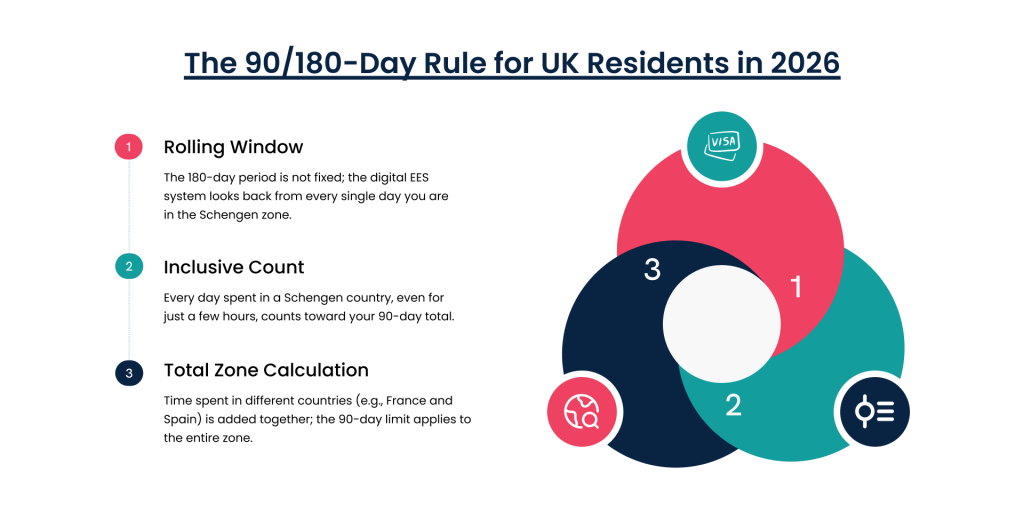
For UK citizens and residents, the calculation of stay is now monitored via the EES.
- Rolling Window: The 180-day period is not fixed; it looks back from every day of your stay.
- Inclusive Count: Every day spent in a Schengen country, even for a few hours, counts toward your 90-day total.
- Total Zone Calculation: Time spent in France adds to time spent in Spain; the 90-day limit applies to the zone.
Permitted Business Activities for Tourist Visa Holders
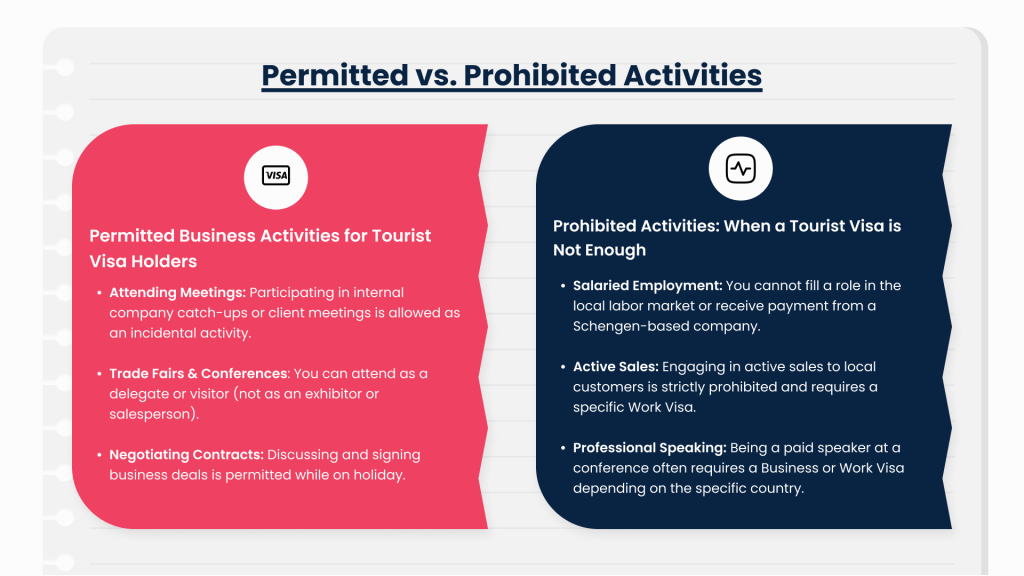
Can you attend a meeting while on a holiday? The definitive answer is yes, but with strict limitations. It is legally permissible to perform certain professional tasks on a tourist visa, provided these are incidental and do not constitute “work” or “employment.”
What You Can Do Legally
At JRI, we frequently architect “Mixed-Use” itineraries for our clients to ensure they satisfy the most rigorous border inspections. Generally, the following are permitted:
- Attending Meetings: Participating in internal company meetings or client catch-ups.
- Trade Fairs and Conferences: Attending as a delegate or visitor (not as an exhibitor).
- Fact-Finding Missions: Researching a location for future investment or site visits.
- Negotiating Contracts: Discussing and signing business deals.
Prohibited Activities: When a Tourist Visa is Not Enough
The most dangerous mistake is confusing “business” with “work.” You cannot:
- Receive payment from a company within the Schengen zone.
- Fill a role in the local labour market.
- Engage in active sales to local customers.
Doing so violates the terms of a Type C visa and can lead to immediate deportation and a multi-year ban.
| Activity Type | Tourist Visa Permission | JRI Compliance Note |
| Sightseeing | Permitted | Primary purpose of the visa. |
| Attending a Meeting | Permitted | Must be incidental to the holiday. |
| Speaking at a Conference | Restricted | May require a Business Visa depending on the country. |
| Salaried Employment | Prohibited | Requires a Work Visa/National D Visa. |
Is your 2026 travel itinerary EES-compliant?
Border digital records are permanent. Don’t let a “mixed-purpose” trip jeopardise your future visas. Speak with JRI’s expert lawyers in Glasgow today for a Border Readiness Audit.
[Secure Your Consultation with JRI Now]
2026 Update: The Entry/Exit System (EES) and Digital Tracking
As of 10 April 2026, the Entry/Exit System (EES) is fully operational at all external Schengen borders. This replaces manual passport stamps with a centralised biometric database. For UK-based professionals, this means your travel intent is now a permanent digital record.
How EES Affects Your Mixed-Purpose Trip
The EES registers your facial image and fingerprints alongside your entry dates.
- Intent Verification: If you enter on a tourist visa but your digital footprint shows only stays in financial districts during business hours, the system may flag your profile for Visa Shopping.
- Automatic Overstay Alerts: The system calculates the 90/180-day rule in real-time. There is no longer any room for error regarding your departure date.
- Enhanced Border Scrutiny: Guards at Glasgow or Edinburgh airports now have instant access to your previous visa applications. Consistency is your best defence.
Essential Documentation to Carry for Dual-Purpose Visits
Even with a valid visa, entry is always at the discretion of the border officer. At JRI, our solicitors advise clients to carry a “Border Pack” to prove they are a Genuine Visitor with legitimate intent.
Your Professional and Leisure Checklist
- Holiday Evidence: Confirmed hotel or Airbnb bookings for your sightseeing stay.
- Incidental Business Proof: An email or letter detailing the meeting or conference you are attending.
- Means of Subsistence: Recent bank statements showing approximately €100 per day of travel.
- Travel Health Insurance: A policy covering all 29 Schengen states with a minimum of €30,000 in medical cover.
- Share Code: For UK residents on a visa, a printout of your eVisa status from the UKVI account is now essential for 2026 travel.
Compliance Risks: Protecting Your Future Travel Rights
Using a tourist visa inappropriately such as for full-time business when your intent was never leisure can be classified as Misrepresentation. If a border official believes you obtained a tourist visa simply because the appointment was easier to secure, the consequences in 2026 are severe.
Potential Penalties for Non-Compliance
- Visa Shopping Flags: Applying to the “wrong” country can lead to entry refusal and a permanent mark on your EES profile.
- Immediate Annulment: If your documents do not match your declared intent, your visa can be cancelled on the spot.
- Future Bans: Serious misrepresentation can lead to a 5-year entry ban across the entire Schengen Area.
How JRI Solicitors in Glasgow Secure Your European Mobility
At JRI, we believe that international travel should be a source of growth, not anxiety. Based at our registered office in Glasgow, our immigration solicitors provide bespoke guidance to professionals and families across Scotland. We understand the nuances of the 2026 EES and the upcoming ETIAS rollouts, ensuring our clients remain one step ahead of changing regulations.
How Our Expert Lawyers Assist You:
- Managing Complex Applications: We handle Multiple-Entry Visa requests, demonstrating your “genuine need” for frequent travel.
- Border Readiness Audits: We review your itinerary to ensure your business and leisure plans are perfectly aligned with UK and EU laws.
- Digital Compliance: We assist UK residents in navigating the shift from BRPs to the eVisa and Share Code system.
- Inclusive Legal Support: We represent all nationalities, providing a high-quality, professional voice for the diverse community in Glasgow.
Whether you are flying from Glasgow Airport or taking the Eurostar from London, ensure your journey is legally fortified.
Ready to secure your next European trip?
Contact JRI’s expert solicitors today for a comprehensive consultation.
Book Your Consultation with JRI Now