Facing a deportation order from the Home Office causes immediate and profound anxiety for individuals and their loved ones. When the State threatens family life and private connections, you need trusted, expert guidance. This post summarises a critical UK court ruling on Article 8 of the European Convention on Human Rights (ECHR) and its application in deportation cases. This judgment provides essential clarity on the legal standard required to successfully challenge a removal decision.
The Role of Article 8 ECHR in UK Immigration Proceedings

The Human Rights Act 1998 incorporates the rights enshrined in the ECHR directly into UK domestic law, allowing you to challenge governmental decisions, including deportation, in UK courts and tribunals. Article 8 ECHR is fundamental: it protects your Right to Respect for Private and Family Life.
This protection influences every deportation decision, forcing the Home Office and the courts to perform a crucial balancing exercise weighing your human rights against the public interest in maintaining effective immigration controls. The recent court ruling defines how judges conduct this balance, making the principles involved vital to understand.
Article 8: The Right to Respect for Private and Family Life

Article 8 guarantees that public authorities must respect your private and family life, your home, and your correspondence.
| Article 8 Component | Key Focus in Immigration Cases |
| Private Life | Long residence, social/cultural integration, personal identity, and the ability to establish relationships in the UK. |
| Family Life | Parents and dependent children in married or civil partnership relationships, and other genuine family ties with established dependency. |
Crucially, Article 8 is a qualified right. This means the State can interfere with your right if the interference meets three conditions:
- It is in accordance with the law.
- It pursues a legitimate aim.
- It is necessary in a democratic society.
The Legal Framework for Deportation in the UK
The statutory basis for deportation primarily rests on the Immigration Act 1971 and the UK Borders Act 2007. When considering deportation, the courts must apply the principles set out in Part 5A of the Nationality, Immigration and Asylum Act 2002.
The Court’s Clarification: Refining the Article 8 Proportionality Test
The recent, pivotal judgment serves to reinforce and clarify the correct application of the Proportionality Test within the statutory framework of the 2002 Act, emphasising that a judicial human rights assessment cannot be reduced to a mere mechanistic application of the rules.
Background and Core Facts of the Case
The Appellant (the term for the person appealing the decision) challenged an Original Deportation Order issued by the Home Office. The case typically involves an individual with established private and/or family life in the UK, such as:
- A parent to a British or settled child.
- An adult who has lived in the UK for a significant period and established strong social ties.
The ruling is significant because it affirmed that the judiciary’s role is to consider all forms of genuine, subsisting family ties and to acknowledge the diverse family structures potentially affected, ensuring an inclusive assessment.
The Court’s Application of the Proportionality Test
The court asserted that domestic legislation and immigration rules guide the assessment but do not replace the court’s ultimate responsibility to conduct a broad evaluative assessment of proportionality as required by Article 8 itself.
Key Judicial Findings on the Proportionality Test:
- Holistic Assessment: The court must conduct a comprehensive assessment of the consequences of removal on the individual and their family, looking at the entire context.
- Immigration Rules: The five-year and ten-year rules (set out in the Home Secretary’s Immigration Rules) define the circumstances where Article 8 applies. However, the court maintains its judicial discretion to consider factors outside these rules in genuinely compelling cases.
Precedential Impact on Future Cases
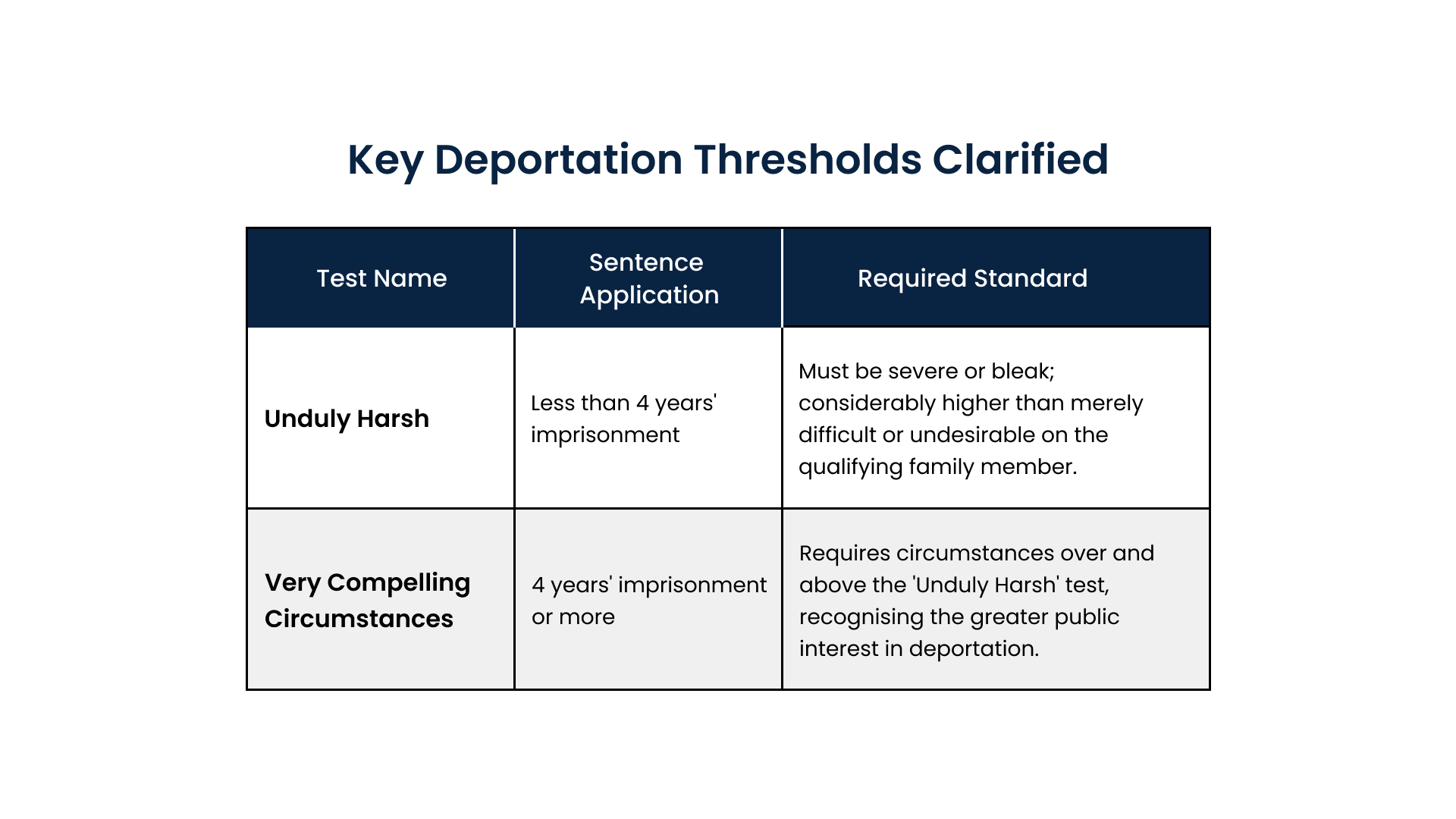
The most significant legal takeaway is the clarification of the “Unduly Harsh” test, a key jargon term found in Section 117C(5) of the Nationality, Immigration and Asylum Act 2002 (for medium-level offenders).
| Threshold Test | Application (Sentence) | Required Standard (Judgment Clarification) |
| Unduly Harsh | 4 years’ imprisonment | Must be severe or bleak; considerably higher than merely difficult or undesirable. Focus is solely on the impact on the partner/child, not the offender’s crime. |
| Very Compelling Circumstances | 4 years’ imprisonment | Requires circumstances that are over and above the Unduly Harsh test, recognising the greater public interest in deportation. |
The judgment reinforces the paramount importance of assessing:
- Integration: The depth of the applicant’s integration into UK society and their length of residence.
- Child’s Best Interests: The assessment of harshness must be made primarily from the child’s perspective, without factoring in the parent’s misconduct.
Securing Representation: Why Expert Solicitors are Essential

Attempting to challenge a deportation decision without expert representation is extremely high risk. The Immigration Rules are complex, and the Proportionality Test demands a comprehensive, persuasive body of evidence.
Expert legal representation is essential to:
- Accurately prepare your Comprehensive Grounds of Appeal.
- Gather robust evidence demonstrating Exceptional Circumstances.
- Effectively argue that the impact would be unduly harsh on qualifying family members.
JRI Solicitors: Specialist Counsel in UK Deportation Appeals
Our expert lawyers possess the in-depth knowledge and experience to mount the strongest possible defence against a Home Office deportation order, leveraging the latest legal precedents like the one summarised here.
JRI’s Expertise: Your Trusted Partner in Deportation Appeals
Our expert lawyers possess the in-depth knowledge and experience to mount the strongest possible defence against a Home Office deportation order, leveraging the latest legal precedents like the one summarised here.
How Our Solicitors Assist You with Article 8 ECHR Cases
We strategically manage your appeal from the outset, providing clarity and confidence during a difficult period. Our process includes:
- Initial Case Assessment and Strategy Formulation: We identify the strongest legal basis and gather all relevant evidence.
- Representation at Tribunals: Our solicitors expertly provide Representation at the First-tier Tribunal and, where necessary, the Upper Tribunal.
Our Strategic Approach to Article 8 ECHR Appeals
We manage your appeal strategically from the outset, providing clarity during a difficult period. Our process includes:
- Initial Case Assessment: We identify the strongest legal basis and gather all relevant evidence.
- Tribunal Representation: Our solicitors provide expert Representation at the First-tier Tribunal and, where necessary, the Upper Tribunal.
Knowledge of UK and Scottish Legal Nuances
We continuously update our knowledge of Case Law to provide you with the most informed and successful strategies.
JRI’s Specialised Knowledge Includes:
- Case Law Monitoring: We monitor every significant Judgment impacting Article 8 ECHR and UK deportation law.
- Judicial Review: Our lawyers competently manage Judicial Review proceedings (a specialist legal challenge to the lawfulness of a public body’s decision in the higher courts, including the Court of Session in Scotland).
Securing Your Future with Expert Legal Advice
The recent court ruling confirms that while the State maintains a strong public interest in immigration control, its power is not absolute. Article 8 ECHR acts as a crucial check on that power, requiring the courts to perform a holistic, evaluative Proportionality Assessment in every case.
Final Summary of the Court Ruling’s Effect
The judgment confirms that the path to success lies in comprehensively demonstrating that the consequences of deportation would be unduly harsh or constitute very compelling circumstances. It is a high hurdle, but one we help clients overcome by applying precise legal standards.
Contact JRI Solicitors in Glasgow Today
Do not jeoparadise your future on incomplete legal advice. JRI Solicitors offers the trusted, authoritative expertise you require to successfully challenge a deportation order based on your human rights. Contact our Glasgow office now to secure your initial consultation and begin building your robust legal defence.