In 2026, the UK’s immigration framework remains focused on economic growth, but it demands absolute precision. While the Skilled Worker route is primarily an employment-led category, there are legal avenues to explore entrepreneurship if you follow the rules. At JRI, our expert immigration solicitors in Glasgow provide the professional clarity and legal fortification you need to ensure your commercial dreams do not jeopardise your residency.
The Scope of Your Permission: What the Skilled Worker Visa Allows
The fundamental rule of the Skilled Worker route is that you are sponsored to perform a specific role for a specific employer. However, the law does not lock you out of all commercial interests. You can legally plant the seeds of a business while maintaining your sponsored status, provided you remain an “investor” or “office holder” rather than a primary worker in the early stages.
Owning Shares and Acting as a Company Director
There is nothing in the UK immigration rules that prevents a Skilled Worker visa holder from owning shares in a UK company. You can legally own 100% of the shares in a private limited company registered at Companies House.
- Directorship: You can legally be listed as a Director.
- Passive Involvement: You can attend board meetings and receive dividends as a shareholder.
- Active Working: You must not perform day-to-day “work” (such as marketing, sales, or technical operations) for this company as your primary job.
The 20-Hour Rule: Supplementary Employment for Entrepreneurs
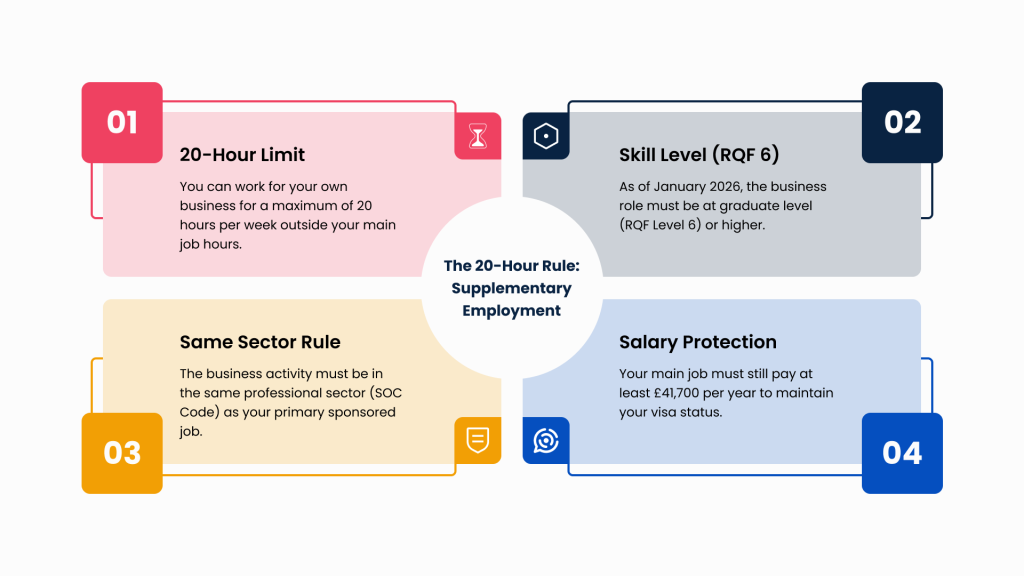
Under the 2026 Supplementary Employment rules, you can work for your own business for up to 20 hours per week, provided you meet strict criteria. Our solicitors at JRI emphasise that this is the most scrutinised area by the Home Office.
- Skill Level: The work must be in a role that is eligible for the Skilled Worker route. From 8 January 2026, this typically means the role must meet RQF Level 6 (graduate level) requirements.
- Same Sector: The activity must be in the same Standard Occupational Classification (SOC) 2020 code as your main job, or it must be a role on the Immigration Salary List (ISL).
- Primary Duty: You must continue to work for your primary sponsor. Your business activity must take place outside your contracted hours for your main employer.
Legal Red Lines: Avoiding Visa Curtailment
At JRI, we often see ambitious professionals risk their status by overextending their “side hustle.” In 2026, the Home Office uses automated data sharing with HMRC to flag potential breaches.
The Prohibitions on Self-Employment
Generally, you must be paid through a PAYE (Pay As You Earn) system. Operating as a Sole Trader or a freelancer is often viewed as a breach of conditions because it constitutes self-employment, which is strictly restricted on this route. If your business pays you a salary as an employee for those 20 supplementary hours, you must handle it with precise payroll documentation.
Why Your Main Job Must Always Remain the Priority
Your main job is the legal anchor of your stay in the UK.
- Salary Floor: In 2026, the standard salary threshold is £41,700. If your salary at your main job falls below this because you reduced your hours to focus on your business, your visa will likely be cancelled.
- Genuine Vacancy: The Home Office may investigate if your primary role is still a “genuine vacancy” if you are spending significant time and energy on a side venture.
Is your business activity risking your visa?
A single compliance error can lead to a 10-year ban. Don’t leave your future to chance. Speak with JRI’s expert lawyers in Glasgow today for a Founder Compliance Audit.
Contact JRI Glasgow for Expert Legal Advice
New for 2026: Digital Compliance and EES Monitoring
The implementation of the Entry/Exit System (EES) in 2026 and the total transition to eVisas mean the Home Office has a real-time digital record of your professional presence.
How the Entry/Exit System (EES) Tracks Your Presence
The EES registers your biometric data fingerprints and facial scans every time you cross a border. This data allows authorities to spot inconsistencies. If you claim to work 40 hours in Glasgow but your digital footprint suggests you are managing a business abroad or working excessive hours elsewhere, the system will trigger an investigation. Full implementation of EES is scheduled for 10 April 2026.
Managing Your UKVI Account and Share Codes
In 2026, physical BRP cards are extinct. You prove your status via a Share Code generated from your UKVI account.
- Transparency: Business partners and banks will use these codes to verify your Right to Work.
- Integrity: Any restriction on your visa is immediately visible. Our solicitors at JRI ensure your digital record remains flawless.
The Strategic Path Forward: Switching to the Innovator Founder Visa
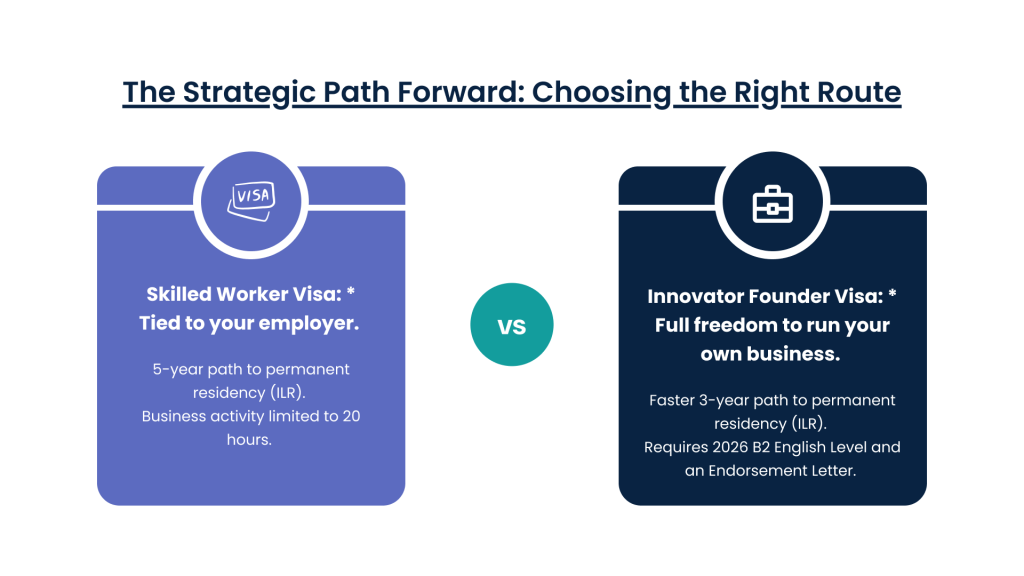
If your business takes off and requires more than 20 hours of your time, the Skilled Worker route is no longer viable. At JRI, our solicitors specialise in “switching” strategies that lead to total entrepreneurial freedom.
Qualifying for Endorsement in 2026
The Innovator Founder Visa is the gold standard for entrepreneurs. To switch, you must receive an endorsement from an approved body confirming your business is:
- Innovative: A new or original business idea.
- Viable: It has a realistic prospect of success.
- Scalable: It has potential for job creation and growth.
The Faster Route to Indefinite Leave to Remain (ILR)
One of the most persuasive reasons to switch is the timeline to settlement. From 8 January 2026, the English requirement for this route has increased to B2 CEFR.
| Feature | Skilled Worker Visa | Innovator Founder Visa |
| Settlement (ILR) Timeline | 5 Years | 3 Years (for successful founders) |
| English Requirement | B2 Mandatory (from Jan 2026) | B2 Mandatory (from Jan 2026) |
| Work Restrictions | Tied to Sponsor | None (for your own business) |
| Salary Requirement | £41,700 | No fixed salary floor |
How JRI Solicitors and Lawyers Assist Glasgow’s Ambitious Founders
At JRI, we believe that the next generation of Scottish innovation will be driven by global talent. Our expert solicitors and lawyers act as your strategic partners in the Glasgow business community. We understand that for international professionals in Scotland, legal compliance is the foundation of commercial success.
Our team provides comprehensive Border Readiness Audits and Sponsor Licence reviews to ensure your commercial dreams don’t jeopardise your residency. We assist diverse founders in managing their UKVI accounts and navigating the complex shift to eVisas, ensuring your 2026 venture is built on solid legal ground. We pride ourselves on an inclusive approach, supporting the next generation of Glasgow’s business leaders from all backgrounds.
Our Expert Assistance Includes:
- Supplementary Work Audits: Verifying that your business role matches your SOC code and skill level.
- Switching Applications: Professional handling of your move to the Innovator Founder or Global Talent routes.
- Corporate Secretarial Support: Ensuring your Companies House filings are immigration-compliant.
- Direct Access to Lawyers: Our Glasgow office is on hand to answer your urgent compliance questions.
Ready to turn your idea into a legal reality?
Contact JRI’s expert solicitors today for a comprehensive consultation. We will ensure your journey from employee to founder is secure.
Book Your Consultation with JRI Now