
For the ambitious professional residing in Glasgow, a Skilled Worker visa is often more than a job permit; it is the foundation for a greater entrepreneurial vision. As we navigate the complexities of 2026, many international residents in Scotland find themselves at a crossroads: they possess the drive to innovate but fear that launching a startup might jeopardise their immigration status.
The Home Office’s total transition to the eVisa system and the implementation of rigorous new salary thresholds have made compliance more transparent and more critical—than ever before. At JRI, our expert immigration solicitors in Glasgow specialise in architecting legal pathways that allow you to innovate with confidence. Whether you are exploring a side venture or ready to lead your own company through Self-Sponsorship, our team ensures your residency remains fortified while your business thrives.
The 2026 Reality: Defining Your Entrepreneurial Rights
In the current legal landscape, the Home Office draws a sharp distinction between being a business owner and a business operator. While anyone can technically register a UK company, your right to “work” for that company is strictly governed by your Conditions of Stay.
In 2026, the digital nature of eVisas means that authorities have real-time visibility into your professional activities. At JRI, our lawyers review your current visa status to ensure that your entrepreneurial actions do not trigger a Visa Curtailment or reset your clock for Indefinite Leave to Remain (ILR).
Permitted Activities for Sponsored Founders in 2026
Understanding what is allowed without a visa change is the first step toward a successful launch. Use the table below as a quick-reference guide for your initial planning stages.
| Activity | Legality | JRI Strategic Condition |
| Registering a UK Ltd Company | Legal | You may be the 100% shareholder at Companies House. |
| Opening a Business Bank Account | Legal | Requires proof of registration and a valid BRP/eVisa. |
| Market Research & Planning | Legal | Permitted as long as it does not constitute “work.” |
| Active Daily Management | Restricted | Limited to 20 hours per week under Supplementary Rules. |
| Sponsoring Employees | Legal | Your company can hold a licence to sponsor others. |
Navigating Supplementary Employment: The 20-Hour Rule
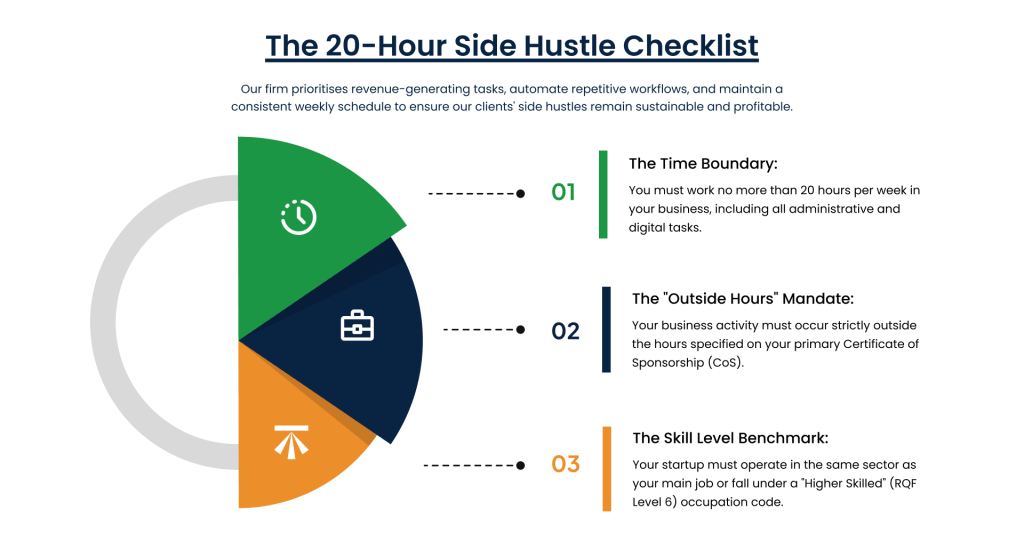
If you intend to work for your business while remaining sponsored by your current employer, you must strictly adhere to the Supplementary Employment framework. In 2026, the Home Office has intensified its focus on the “skill level” of these side ventures.
The Three Pillars of Compliant Side Ventures
To protect your residency, JRI’s solicitors ensure your business activity satisfies these three mandatory criteria:
- The Time Boundary: You must work no more than 20 hours per week in your business. This includes administrative tasks, such as bookkeeping and client emails.
- The “Outside Hours” Mandate: Your business work must occur strictly outside the hours specified on your primary Certificate of Sponsorship (CoS).
- The Skill Level Benchmark: Your business must operate in the same professional sector as your primary job OR fall under an eligible “Higher Skilled” (RQF Level 6) occupation code.
Strategic Evolution: The “Self-Sponsorship” Route
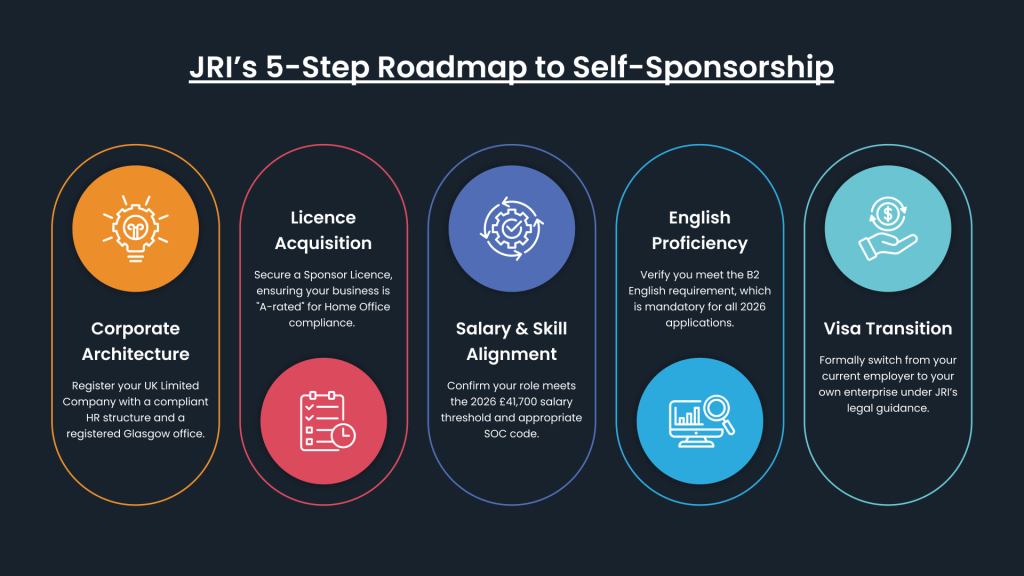
For many Glasgow founders, the 20-hour limit is an obstacle to scaling. JRI’s expert lawyers frequently facilitate a more robust solution: Self-Sponsorship. This involves establishing your own UK entity that then sponsors your own Skilled Worker visa, allowing you to work full-time as the CEO or Director of your business.
JRI’s 5-Step Roadmap to Self-Sponsorship
Our team navigates the administrative burden, allowing you to focus on your business model.
- Corporate Architecture: We assist in registering your UK Limited Company with a compliant HR structure.
- Licence Acquisition: JRI manages the Sponsor Licence application, ensuring your business is “A-rated” by the Home Office.
- Salary & Skill Alignment: We ensure your role meets the 2026 £41,700 salary threshold (or the going rate for your SOC code).
- English Proficiency: We confirm you meet the B2 English requirement (mandatory for first-time applicants as of 8 January 2026).
- Visa Transition: Our solicitors manage the formal switch from your current employer to your own enterprise.
Is your business idea ready for the £41,700 threshold?
In 2026, precision is your best defence against visa refusal. Speak with JRI’s expert Glasgow solicitors today for a Fixed-Fee Feasibility Assessment of your startup.
Contact a JRI Specialist Now
Compliance Risks: Protecting Your Path to Settlement
Building a business in Scotland is a long-term play. The ultimate goal for most is Indefinite Leave to Remain (ILR), which grants you permanent security in the UK. However, the Home Office treats any unauthorised business activity as a “break in continuous residence,” which could delay your settlement by years.
Avoiding Common “Red Flags” for Founders
Our solicitors have identified several common pitfalls that founders must avoid in 2026:
- Substantive Change in Employment: If your primary job duties shift significantly to accommodate your business, you may be in breach of your visa.
- Dividend Misreporting: Taking “drawings” from your business that exceed the value of a 20-hour-per-week role can trigger a secondary employment audit.
- Missing eVisa Updates: Every change in your company’s address or your status as a Director must be reported via your UKVI digital account.
Maintenance of the “Compliance Folder”
JRI recommends that every sponsored entrepreneur maintains a dedicated compliance folder. This folder acts as your “shield” during a Home Office audit and should contain:
- Daily Time Logs: Detailed records of hours spent on business tasks.
- HMRC Correspondence: Evidence of correct National Insurance and PAYE contributions.
- Client Contracts: Proof that your business activity aligns with the Higher Skilled SOC codes.
Why JRI is Glasgow’s Premier Choice for Founders
The 2026 immigration landscape is intricate, but it is not an entry barrier. It is a framework that rewards those who seek professional guidance. At JRI, our solicitors are deeply rooted in Glasgow’s vibrant startup ecosystem. We combine local market insights with world-class immigration expertise to ensure your business has the strongest possible legal foundation.
How JRI’s Expert Lawyers Assist You:
- Bespoke SOC Code Mapping: We ensure your startup role is categorised correctly to meet RQF Level 6 requirements.
- Sponsor Management: JRI can act as your “Level 1 User,” managing the day-to-day administration of your company’s Sponsor Licence.
- Inclusive Legal Support: We represent founders from all backgrounds, providing clear, persuasive, and culturally sensitive advice.
- ILR Safeguarding: We provide a 5-year roadmap, ensuring every business move you make today strengthens your claim for permanent residency tomorrow.