
To secure your continued presence in the UK corporate landscape, you need more than just a renewed contract; you need a precise legal blueprint. The Global Business Mobility (GBM) visa routes specifically for Senior or Specialist Workers—allow international talent to maintain their impact in Glasgow. However, extensions are not automatic. In the current 2026 regulatory environment, the Home Office applies rigorous checks on Maximum Stay limits and updated salary thresholds.
At JRI, our expert immigration solicitors in Glasgow provide the technical precision and authoritative advocacy required to extend your permission and safeguard your business continuity.
Understanding the GBM Extension Process in 2026
The Global Business Mobility routes serve as a bridge for temporary corporate assignments. While these visas do not lead directly to settlement, they offer significant flexibility for professionals finishing vital projects in Scotland. An extension is officially an application for Permission to Stay, which you must submit from within the UK before your current visa expires.
Assessing Your Eligibility for a Further Grant of Leave
To qualify for an extension, you must continue working in the same occupation code for the same employer who sponsored your initial entry. Your sponsor must also maintain an A-rated status on the Home Office register. At JRI, we perform a Pre-Submission Audit to ensure your role still meets the RQF Level 6 (graduate-level) requirement. Even minor changes in job titles or duties can lead to a refusal if they no longer align with the original Certificate of Sponsorship (CoS).
Key Differences Between GBM Categories: Extension Rules
The rules for extending your stay vary significantly depending on your specific GBM sub-category:
- Senior or Specialist Worker Extensions: You can apply to extend your stay as many times as necessary, provided you do not hit the cumulative time cap.
- UK Expansion Worker (The Two-Year Limit): This route has a hard cap. You can only extend for one additional year after your initial 12-month grant. Once you reach the two-year limit, you must switch to a different route, such as the Skilled Worker visa, to remain in Glasgow.
Maximum Total Stay: Calculating Your Cumulative Time
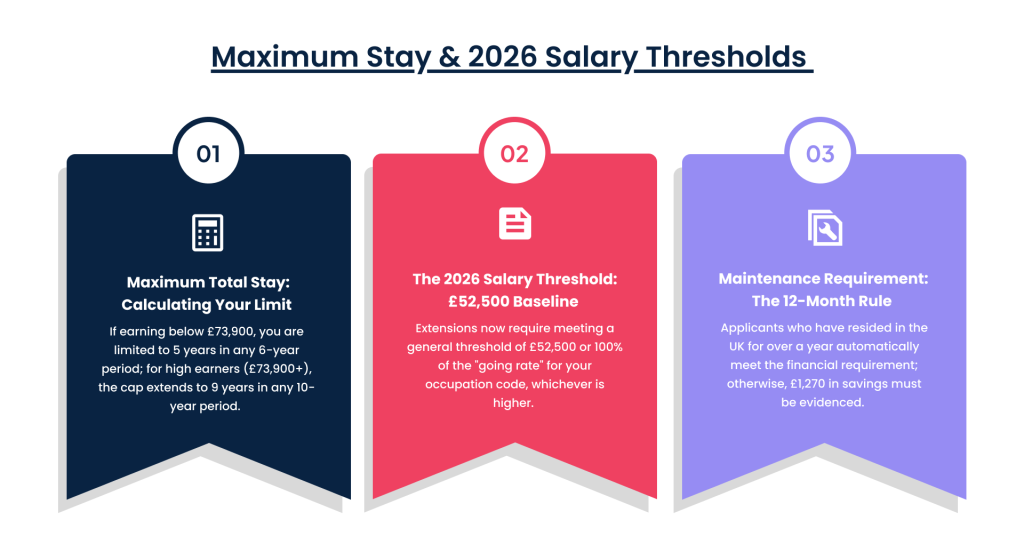
The Home Office enforces a strict Maximum Total Stay across the GBM routes. Calculating this correctly is the most vital part of your extension strategy.
| Salary Level | Maximum Total Stay | Calculation Period |
| Below £73,900 | 5 Years | In any 6-year period |
| £73,900 or More | 9 Years | In any 10-year period |
Core Requirements for a Successful Extension Application
Securing an extension in 2026 requires meeting updated financial benchmarks. Our lawyers at JRI verify that your compensation package aligns with the latest Statement of Changes in Immigration Rules.
Obtaining a Valid Certificate of Sponsorship (CoS)
Your employer must assign a new Certificate of Sponsorship (CoS). This is a digital record with a unique reference number. In 2026, the Home Office requires the CoS to be issued no more than three months before your application date. We help Glasgow businesses manage their Sponsor Management System (SMS) to ensure these records are flawless.
Meeting the 2026 Salary Thresholds and Going Rates
The financial requirements for an extension are twofold. You must meet the higher of:
- The General Threshold: Currently set at £52,500 for most Senior or Specialist Workers.
- The Occupation-Specific ‘Going Rate’: Based on 100% of the pro-rated median earnings for your specific job code.
The Maintenance Requirement: Financial Evidence
If you have lived in the UK with valid permission for 12 months or more on the date of your application, you automatically meet the financial requirement. You do not need to show bank statements. If you have been here for less than a year, you must evidence at least £1,270 in personal savings, held for 28 consecutive days.
Approaching your visa expiry date? Don’t risk a gap in your employment or a breach of conditions. Our solicitors in Glasgow are ready to manage your extension with technical precision.
Consult with a JRI Extension Specialist Today
JRI’s Step-by-Step Strategic Framework for Extensions
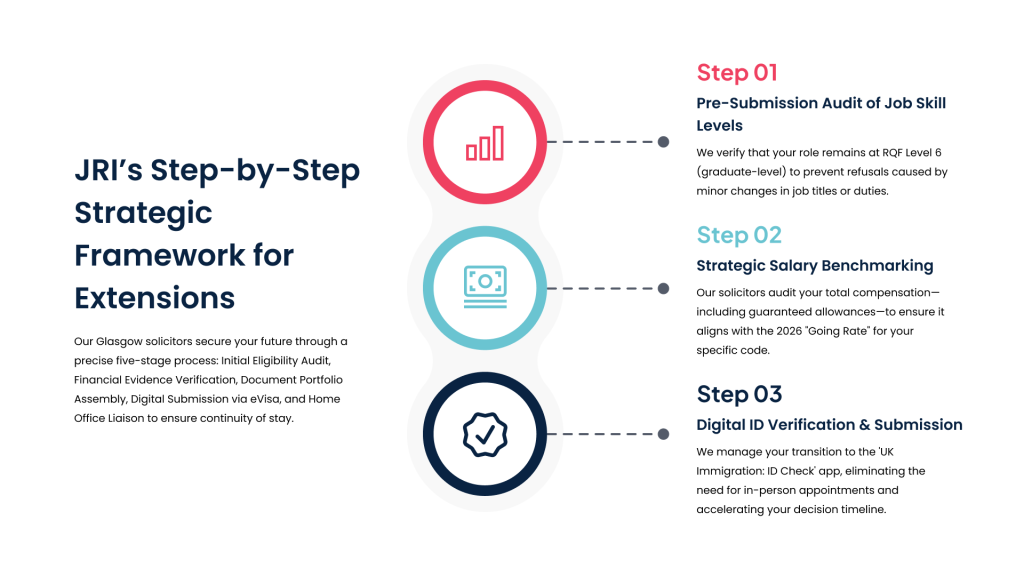
Our firm uses a structured methodology to ensure your Leave to Remain is granted without the stress of Requests for Evidence (RFEs).
- Step 1: Pre-Submission Audit of Job Skill Levels: We verify that your responsibilities still align with the graduate-level requirements of the Global Business Mobility framework.
- Step 2: Strategic Salary Benchmarking: We audit your pay, including guaranteed allowances such as London weighting or mobility premiums, ensuring they meet the 2026 “Going Rate.”
- Step 3: Digital ID Verification: Most extension applicants now use the ‘UK Immigration: ID Check’ app. This eliminates the need for an in-person appointment at a UKVCAS centre in Glasgow, speeding up the process.
Legal Considerations for Businesses in Glasgow
For many international professionals in Glasgow, a GBM visa is a stepping stone. A critical limitation of this route is that it does not lead directly to Indefinite Leave to Remain (ILR). However, many of our clients choose to Switch to the Skilled Worker route during their extension phase. This transition allows you to count your time towards the five-year residency requirement for permanent settlement in the UK.
How JRI’s Solicitors Support Your UK Business Continuity
Choosing JRI means choosing a partner who understands the local Glasgow business landscape as well as the technicalities of UK immigration law.
Our solicitors draft a comprehensive Legal Briefing to accompany your extension. This letter highlights how your specific role and salary meet the 2026 requirements, preempting any potential concerns from Home Office adjudicators. With direct access to our experts in our Glasgow office, you can ensure your move from a temporary assignment to a long-term career in Scotland is handled with the expertise it deserves.