
Securing entry for international partners and executives is vital for the growth of Glasgow’s commercial sector. However, as of January 2026, the Home Office has intensified its focus on the “genuineness” of business visitors. A simple business meeting can quickly escalate into a border refusal if the officer suspects you are undertaking prohibited work. At JRI, we translate ‘Appendix Visitor’ into a clear operational roadmap, ensuring your Glasgow business visit is compliant from departure to entry.
Our lawyers in Glasgow offer the clarity needed to satisfy border officials while ensuring your commercial objectives remain protected. This guide explains how to ensure your visit visa and your reputation survive the latest regulatory shifts.
The 2026 Enforcement Era: Why Business Visitors Face Higher Scrutiny

In 2026, the Home Office uses ‘Digital Border’ analytics to flag frequent visitors. If your travel pattern suggests you are ‘living’ in the UK via visitor visas, entry will be refused. The Home Office now utilises advanced data-sharing to identify patterns of frequent or successive visits that might suggest a visitor is effectively living or working in the UK. For a business traveller, this means the justification for your trip must be beyond reproach.
The February 25 Deadline: Mandatory ETA for US, EU, and Global Visitors
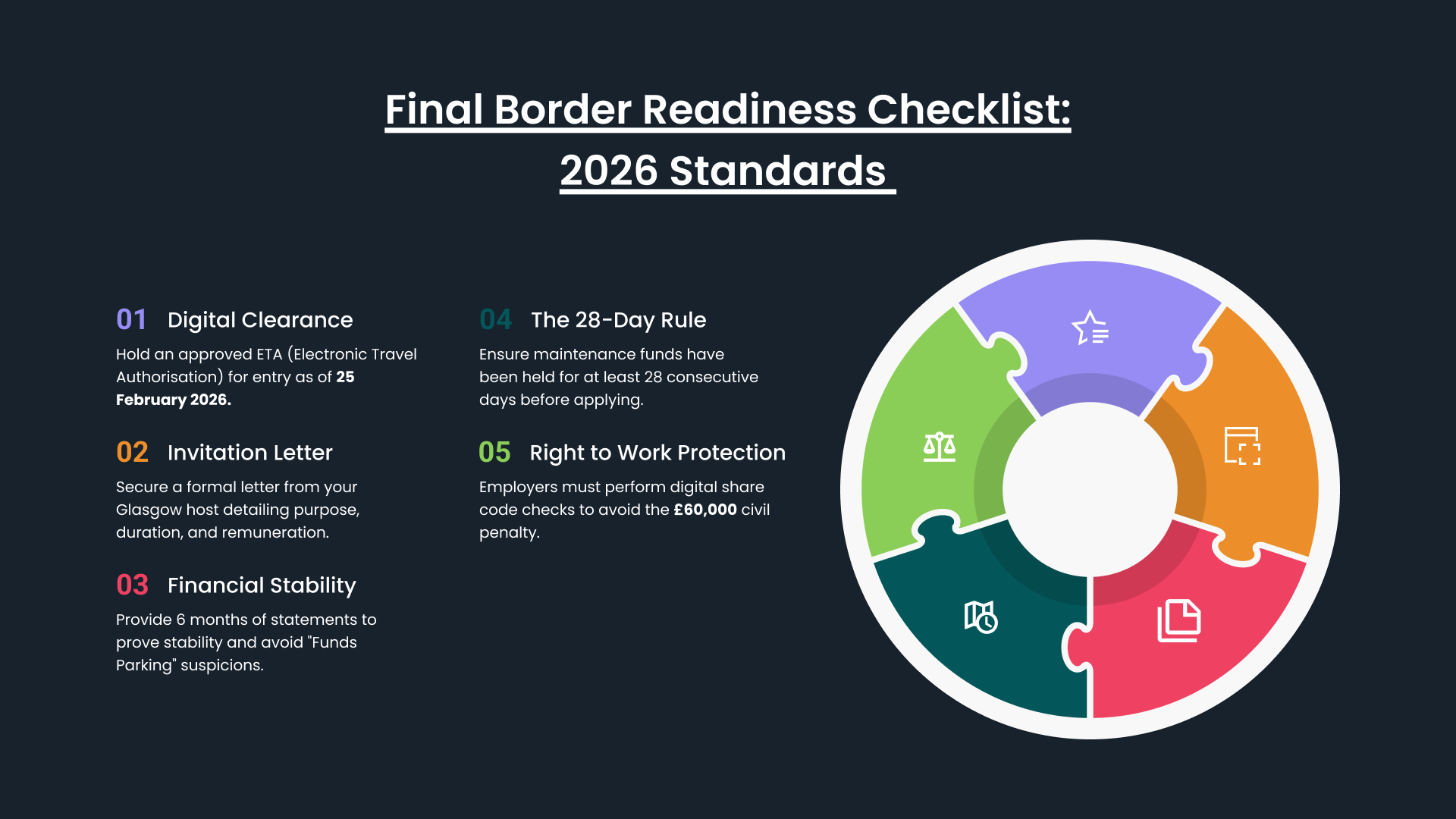
A significant milestone occurs on 25 February 2026. From this date, the Electronic Travel Authorisation (ETA) scheme is fully enforced for all non-visa nationals, including EU, US, and Australian citizens. An ETA is not a “lite” visa; it is a mandatory security clearance. Carriers will deny boarding to any traveller without valid authorisation. JRI experts assist corporate clients in ensuring their entire travelling team holds the correct permissions before reaching the airport.
Appendix Visitor: The Thin Line Between Business and Prohibited Work
The Immigration Rules Appendix Visitor sets out the definitive list of what you can and cannot do. The most frequent cause for entry refusal is the “Intent to Work.” If your activities involve providing goods or services directly to UK clients or filling a role within a UK company, you are in breach of your conditions.
Essential Compliance: Identifying Permitted Business Activities
To remain compliant, you must ensure your activities fall strictly within the Permitted Activities framework. In 2026, the Home Office has expanded some definitions while tightening others, particularly around remote working.
Meetings, Negotiations, and Site Visits: Staying Within the Rules
Standard business activities are generally safe. These include:
- Attending meetings, conferences, seminars, and interviews.
- Negotiating and signing deals or contracts.
- Carrying out site visits and inspections.
- Gathering information for your employment overseas.
- Remote Working: You may answer emails or join calls relating to your overseas job, provided this is not the primary reason for your visit.
The “Intra-Corporate” Exception for Training and Knowledge Sharing
If you are an employee of an overseas company, you can undertake certain activities with a UK branch of the same corporate group. This includes advising, consulting, troubleshooting, and sharing skills on a specific internal project.
Avoiding the Trap of “Productive Work” and Labour Supply
You must avoid any activity that amounts to “productive work.” This means you cannot provide services to a UK customer on behalf of your overseas employer if that work is typically done by a UK employee. At JRI, we audit your proposed itinerary to ensure no activity could be interpreted as the “supply of labour.”
Is your executive itinerary “Home Office Ready”? A border refusal can lead to a 10-year ban and massive commercial disruption. Contact JRI’s business immigration specialists today for a pre-travel compliance audit.
Evidence-Based Entry: Preparing Your Supporting Document Pack
In 2026, a valid passport is not enough. You must carry evidence that proves you are a Genuine Visitor who intends to leave at the end of your stay. The Home Office often rejects applications based on “vague travel plans” or “lack of ties to home.”
The Invitation Letter: Essential Requirements for Glasgow Hosts
An invitation letter from a UK organisation is a cornerstone of a successful entry. Our lawyers ensure your letters include:
- Detailed Itinerary: The specific purpose and activities planned.
- Duration: A fixed end date (typically not exceeding six months).
- Remuneration Confirmation: Verification that the visitor remains paid overseas.
- Financial Support: Clarity on who is covering travel and maintenance costs.
Financial Scrutiny: Avoiding “Funds Parking”
A ‘vague’ invitation is a refusal trigger. JRI drafts ‘Border-Ready’ invitation letters that explicitly state the visitor remains on overseas payroll, a key requirement for 2026 compliance.. Large, sudden deposits—known as “funds parking”—raise suspicions that you are borrowing money just to secure the visa. You must provide at least six months of consistent bank history to prove financial stability.
Business Insurance
The stakes for businesses have reached record levels. As of 13 February 2026, the civil penalties for employing individuals without the correct right to work have tripled.
- First Breach: Up to £45,000 per worker.
- Repeat Breach: Up to £60,000 per worker.
If your business visitor performs work that falls outside the permitted activities, they are effectively “working illegally.” This triggers the same headline fines for your company as hiring an undocumented worker. A Business Visitor performing ‘unauthorised work’ is legally an ‘illegal worker.’ JRI’s audits provide your firm with a ‘Statutory Excuse,’ shielding you from the £60,000-per-head penalty.
Why JRI is the Trusted Voice for Business Immigration in Scotland
From the satellite labs of Finnieston to the boardrooms of West George Street, JRI ensures Glasgow’s global partnerships aren’t stalled by border bureaucracy. To thrive in this ecosystem, businesses require a legal partner that understands the local pulse and the global regulatory tide. At JRI, our brand visibility is built on a foundation of intellectual honesty and professional excellence. We provide inclusive legal support that is both authoritative and accessible, ensuring Glasgow remains open for global business.
Partner with JRI: Expert Lawyers and Solicitors on Hand
The experts at JRI handle the heavy lifting of your immigration needs. We act as your strategic partners, ensuring your business visits are protected from the risk of refusals or re-entry bans.
How Our Legal Experts Fortify Your Business Entry Strategy
Our solicitors and lawyers provide a comprehensive suite of services to keep your global operations moving:
- Pre-Travel Audits: We review itineraries to ensure all activities are legally “permitted.”
- Document Drafting: We assist in preparing high-quality invitation letters and financial evidence.
- ETA and Visa Management: We handle the application process for both visa and non-visa nationals.
- Border Support: We provide rapid legal advice if a traveller faces questioning at the border.
Protect Your Business Entry Is your executive’s itinerary compliant with 2026 rules? Don’t leave it to chance at the border. [Button: Book a Pre-Travel Compliance Audit