Global business demands a precise, compliant approach to talent mobility. For overseas companies setting sights on the UK, specifically the dynamic market of Glasgow and Scotland, the Global Business Mobility (GBM) visa framework offers two primary, yet fundamentally different, solutions. The choice between the Senior or Specialist Worker route (for transfers) and the UK Expansion Worker route (for new establishment) dictates everything: from your visa timeline to your long-term staffing strategy.
A fundamental legal error at this stage can derail your entire UK strategy. At JRI, our expert immigration lawyers cut through the administrative ambiguity of the UK Immigration Rules. We provide the strategic clarity necessary to ensure your corporate transfer or establishment plan is legally sound from day one. We identify the exact route that aligns with your specific corporate goals, protecting your compliance and safeguarding your investment in the UK.
Understanding the Corporate Goal: Transfer vs. Establishment
The core distinction between these two routes lies in your UK entity’s current operational status. Are you transferring existing staff to an already trading branch (Senior Specialist), or are you sending staff to create the initial UK footprint (UK Expansion Worker)? We mandate a precise review of your UK entity’s current operational status to ensure you apply correctly.
Senior or Specialist Worker: The Intra-Company Transfer Model

This route is the direct successor to the old Intra-Company Transfer (ICT) visa. It serves the needs of multinational groups moving established, high-skilled employees into a UK branch or subsidiary that is already actively trading.
- Purpose: Temporary Assignments and Staff Relocation
- This route is exclusively for transferring existing staff who bring specialist skills or occupy senior management roles essential to the UK operation.
- The UK company must hold a GBM sponsor licence and demonstrate the employment is genuine and meets the salary and skill requirements under UK law.
- Our expertise: We verify the Genuine Vacancy Test requirements are met, ensuring the role is legitimate and not created solely to facilitate migration.
- Key Legal Jargon: Defining ‘Linked Overseas Business’ and ‘High Earner’
- Linked Overseas Business: We verify the required legal relationship. The overseas business and the UK sponsor must be linked by common ownership or control (e.g., both are subsidiaries of the same parent company). Our solicitors review your corporate structure to prove this vital link to the Home Office.
- High Earner: This designation is crucial. A worker is considered a High Earner if they will be paid an annual gross salary of £73,900 or more. This status waives the 12-month overseas employment rule and extends the maximum duration of their stay in the UK, offering valuable flexibility.
UK Expansion Worker: The First Footprint Strategy
This route is designed specifically as a temporary vehicle for market entry. It is for businesses that have a genuine overseas trading presence but do not yet have a fully trading UK entity.
- Purpose: Establishing a UK Trading Presence in Glasgow and Scotland
- The UK Expansion Worker visa is for senior managers or specialists whose sole purpose is to establish the UK subsidiary or branch.
- Critical Restriction: The UK entity must not yet be actively trading. If your company has already commenced business activities, this route is wrong, and refusal is highly likely. JRI ensures your expansion timeline is compliant with this strict rule, managing the risk of application rejection.
- Key Legal Jargon: Defining ‘UK Footprint’ and ‘Authorising Officer’
- UK Footprint: You must prove you have a physical presence, typically through registering with Companies House (as a UK establishment or subsidiary) and evidence of acquiring physical UK premises (e.g., a lease agreement in Glasgow).
- Authorising Officer: This senior person, often based overseas initially, is responsible for all sponsorship compliance and communication with the Home Office. The overseas business can only sponsor a maximum of five UK Expansion Workers at any one time, underscoring the route’s limited nature. Our solicitors ensure this individual fully understands their sponsor duties.
The Core Differentiation: Eligibility and Sponsor Obligations
Choosing the correct GBM route requires strict adherence to salary thresholds and demonstrating corporate readiness. We guide corporate clients through these pivotal legal requirements.
Sponsorship Requirements: Trading Status and Licences
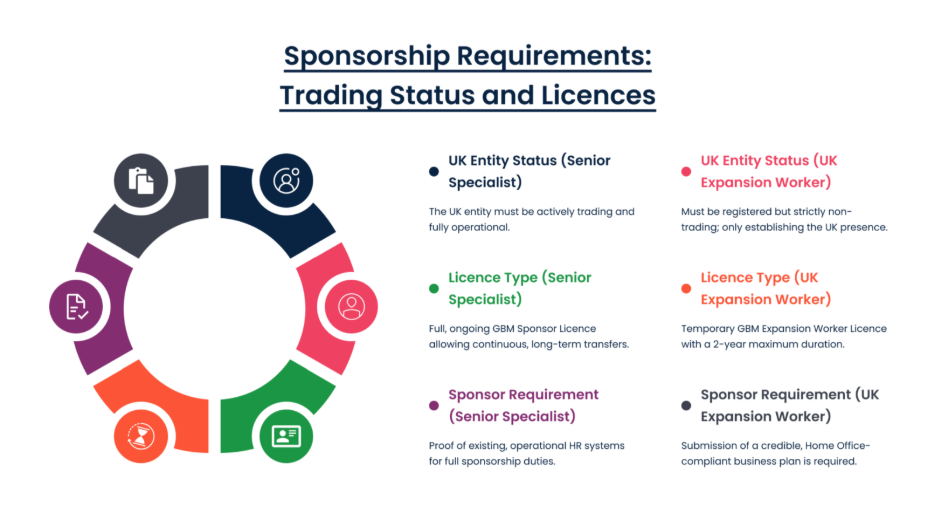
The Home Office views this licence applications through entirely different lenses based on your trading status. We eliminate ambiguity with a clear comparison:
| Feature | Senior or Specialist Worker | UK Expansion Worker |
| UK Entity Status | Must be actively trading | Must be registered but strictly non-trading (establishing a footprint) |
| Licence Type | Full GBM Sponsor Licence (allows ongoing transfers) | Temporary GBM Expansion Worker Licence (max. 2 years) |
| Sponsor Requirement | Proof of existing, operational HR systems | Submission of a credible business plan |
Licence Scope and Compliance:
- Both routes require a GBM sponsor licence, but the Expansion Worker licence is temporary and restricted.
- The Senior Specialist licence is broader, requiring proof of existing HR systems capable of meeting full sponsorship duties. Our lawyers assist with the setup of these systems, ensuring audit readiness from day one.
Applicant Eligibility and Overseas Experience
Both routes demand workers are at least RQF Level 6 (graduate-level skill), but the prior experience requirement differs significantly based on pay.
- Required Overseas Employment: The 12-Month Rule Exception
- General Rule: The sponsored worker must have worked for the overseas linked business for a cumulative period of at least 12 months prior to the application date.
- The High Earner Exception: Workers designated as High Earners (paid £73,900 or more) are exempt from this 12-month rule. Our expertise ensures you utilise this exemption legally to expedite urgent, high-value transfers without delay.
- The Salary Threshold and ‘Going Rate’ Comparison (Accurate 2024/2025 Rates):
- All GBM roles must satisfy two tests: the general salary threshold and the ‘going rate’ for the specific job’s SOC code (whichever is higher).
- Current General Threshold: The minimum general salary required is £48,500 per year.
- Compliance Guarantee: We accurately map the role to the correct Standard Occupational Classification (SOC) code and verify that your offered salary meets or exceeds the Home Office’s published going rate. This checking is a foundational service that prevents refusals based on pay discrepancies.
Legal Alert: Are You Risking Your UK Expansion?
The GBM visa framework is rigid. Applying for the wrong route, failing the 12-month rule check, or falling below the correct Going Rate will lead to immediate refusal and loss of time and investment. JRI’s expert immigration solicitors in Glasgow provide an authoritative legal review of your corporate mobility strategy before you apply.
Stop guessing the rules—let JRI ensure compliance. Contact us today to secure a definitive legal strategy consultation.
Strategic Impact: Duration, Dependants, and Future Planning
The temporary nature of the Global Business Mobility (GBM) routes necessitates astute strategic foresight for your corporate planning. We help you plan not only for immediate staff deployment and retention but also for the critical, long-term path to permanent residency for your key employees in the UK.
Visa Duration and Maximum Stay Caps
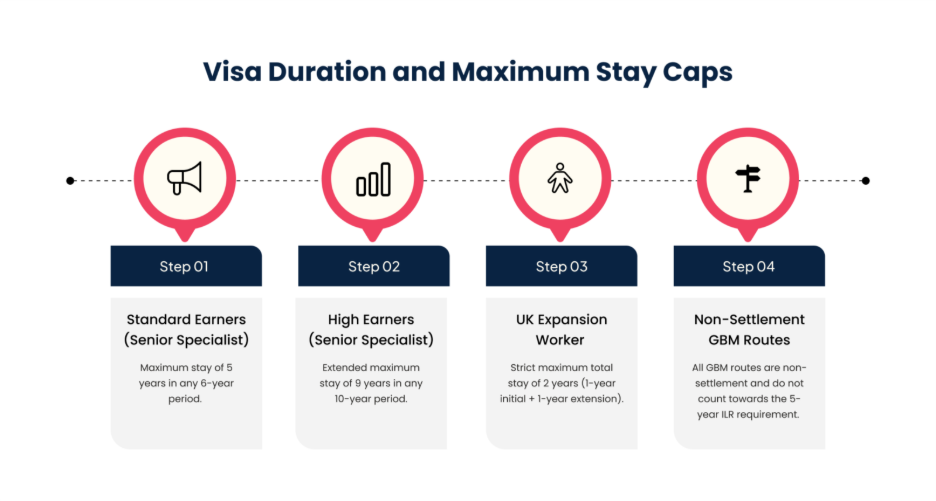
Understanding these cumulative caps is crucial for long-term staff deployment and avoiding non-compliant overstays.
- Senior Specialist: The 5-in-6 vs. 9-in-10 Year Rule
- Standard Earners: Workers earning less than £73,900 are limited to a maximum stay of 5 years in any 6-year period across all GBM and legacy ICT routes.
- High Earners: Those earning £73,900 or more benefit from an extended cap of 9 years in any 10-year period. This distinction is vital for multinational clients requiring longer project assignments. Our solicitors manage this calculation to ensure no breach occurs.
- UK Expansion Worker: The Two-Year Non-Settlement Limit
- The maximum total stay permitted on the UK Expansion Worker visa is two years (one initial grant plus one 12-month extension).
- This route is purely a temporary bridge. The worker must then leave the UK or switch to a different visa route (like the Skilled Worker route) if they plan to stay long-term. We manage this transition proactively to avoid disruption.
The Critical Question of Settlement (ILR)

The temporary nature of these visas has a defining impact on an employee’s ability to secure permanent residency in the UK.
- Temporary Status: Why GBM Routes Do Not Lead to Permanent Residence
- We must be clear: all GBM routes are designated as non-settlement routes. Time spent on these visas does not count towards the five-year requirement for Indefinite Leave to Remain (ILR). This information must be clearly communicated to sponsored employees.
- Future Strategy: Switching to the Skilled Worker Route
- For staff retention and rewarding long-term talent, the strategic solution is transitioning the employee to the Skilled Worker visa route, which is a settlement path.
- The JRI Solution: Once the UK entity is established and trading, we manage the legal process of upgrading your temporary Expansion Worker Licence to a Full Skilled Worker Sponsor Licence and handle the seamless in-country switching application for your key staff. We turn a temporary stay into a secure future.
JRI’s Legal Expertise: Securing Your Global Mobility Strategy in Scotland
Our reputation as leading immigration solicitors in Glasgow is built on successful outcomes and a deep commitment to our corporate clients across Scotland. We understand that effective global mobility is crucial to your business success, extending far beyond paperwork. We do not just process visas; we secure your operational integrity and market entry strategy. Our expert lawyers provide the authoritative, high-level legal oversight necessary to ensure your talent transfers and expansion plans remain compliant with UK law, protecting your company’s valuable Sponsor Licence status.
Strategic Guidance for Global Talent Transfer
We see ourselves as an extension of your in-house HR and legal teams, focused entirely on compliance and efficiency.
- Ensuring Compliance with Sponsorship Duties in the UK
- We guide your Authorising Officer and key personnel on fulfilling all ongoing sponsor duties under the Home Office Sponsor Guidance. This includes mandatory duties like:
- Reporting changes in circumstances (e.g., changes to the worker’s salary or job location).
- Maintaining accurate employee records and monitoring sponsored workers’ attendance.
- Compliance with reporting requirements during UKVI audits.
- JRI’s Advantage: We provide Glasgow-based support for ongoing compliance, ensuring you are always ready for a Home Office audit.
- Mitigating Risk in Complex Intra-Group Structures
- We specialise in defining and proving the complex legal links of ‘Common Ownership’ and ‘Control’ required for the Senior Specialist route.
- We remove the Home Office’s suspicion regarding the authenticity of transfers between linked entities, providing legal certainty for multinational corporate transfers by supplying comprehensive, court-ready corporate documentation.
The JRI Advantage for UK Expansion
The UK Expansion Worker route is temporary and conditional; our expertise makes the transition to permanent status predictable and successful.
- Defining the Expansion Plan and ‘Footprint’ Evidence
- Our lawyers craft the mandatory credible business plan that rigorously satisfies the Home Office’s scrutiny of your expansion intent. We compile the legally necessary ‘UK Footprint’ documentation (e.g., Companies House registration, confirmed lease agreements) required for licence application success.
- Converting the Expansion Worker Licence to a Full Sponsor Licence
- The goal is to move your entity from a temporary Expansion Worker Licence to a Full Skilled Worker Sponsor Licence. We project-manage this critical legal transition within the two-year window, ensuring your UK branch is fully compliant to retain and recruit staff for the long term. This seamless upgrade is vital for staff retention.
Actionable Legal Checklist: Compliance for Your UK Business
Ensure you gather the following essential documentation. Our solicitors use these checklists as the starting point for every GBM application, guaranteeing completeness.
Document Checklist for Senior or Specialist Worker Applications
- Valid Certificate of Sponsorship (CoS) from the UK sponsor.
- Proof of the financial maintenance requirement (£1,270 unless certified by an ‘A-rated’ sponsor).
- Evidence of 12 months overseas employment with the linked entity (waived for High Earners).
- Employment contract detailing salary that meets the minimum £48,500 threshold or the Going Rate for the SOC code (whichever is higher).
- Corporate documents proving the common ownership and control link between the overseas employer and the UK sponsor.
Key Compliance Points for the UK Expansion Worker Sponsor
- Strict Non-Trading Status: The UK entity must not be actively trading until the licence is upgraded. Any income must relate only to administrative setup.
- Worker Cap: Strictly adhere to the maximum limit of 5 workers sponsored under this licence at any one time.
- Authorising Officer (AO): The AO must be a senior, genuine employee who is either a UK resident or whose overseas base is fully justified in the application.
- Licence Upgrade Deadline: Plan to apply for the Full Skilled Worker Sponsor Licence well within the 2-year maximum stay limit.
- Credible Business Plan: Maintain the original credible business plan and prove that key milestones are being met to satisfy UKVI review.
The complexity of the Global Business Mobility routes demands expert legal oversight from a firm that understands both UK law and corporate strategy. JRI Solicitors are on hand in Glasgow and Scotland to secure your inter-company transfers and manage your seamless expansion.
Do not compromise your growth potential with non-compliant visa applications. Contact JRI today to speak with one of our expert lawyers and establish your authoritative UK mobility strategy.