


Facing immigration detention presents serious challenges to you and your family. If the Home Office detains an individual, securing their release via Immigration Bail becomes critical. This process often necessitates finding a Financial Condition Supporter (FCS). This guide creates clarity on this crucial role, outlining the legal obligations and risks under UK law
Establishing the Role of the Financial Condition Supporter (FCS)
We define the Financial Condition Supporter (FCS) as an individual who agrees to pay a specified amount of money, the financial condition, if the person released on bail breaches any of their imposed terms. This role is fundamental to the bail application’s success, demonstrating a tangible commitment to compliance with bail conditions to the Immigration Tribunal or Home Office.
What is an FCS?
The FCS acts as a financial guarantor for the detained person. They are formally approved by the decision-maker and promise a sum of money that they will forfeit if the applicant fails to comply with any part of their release terms, such as reporting or residence requirements. The commitment assures the authorities that there is a financial incentive exists for the applicant to adhere to the terms of their release.
Distinction between FCS and Surety
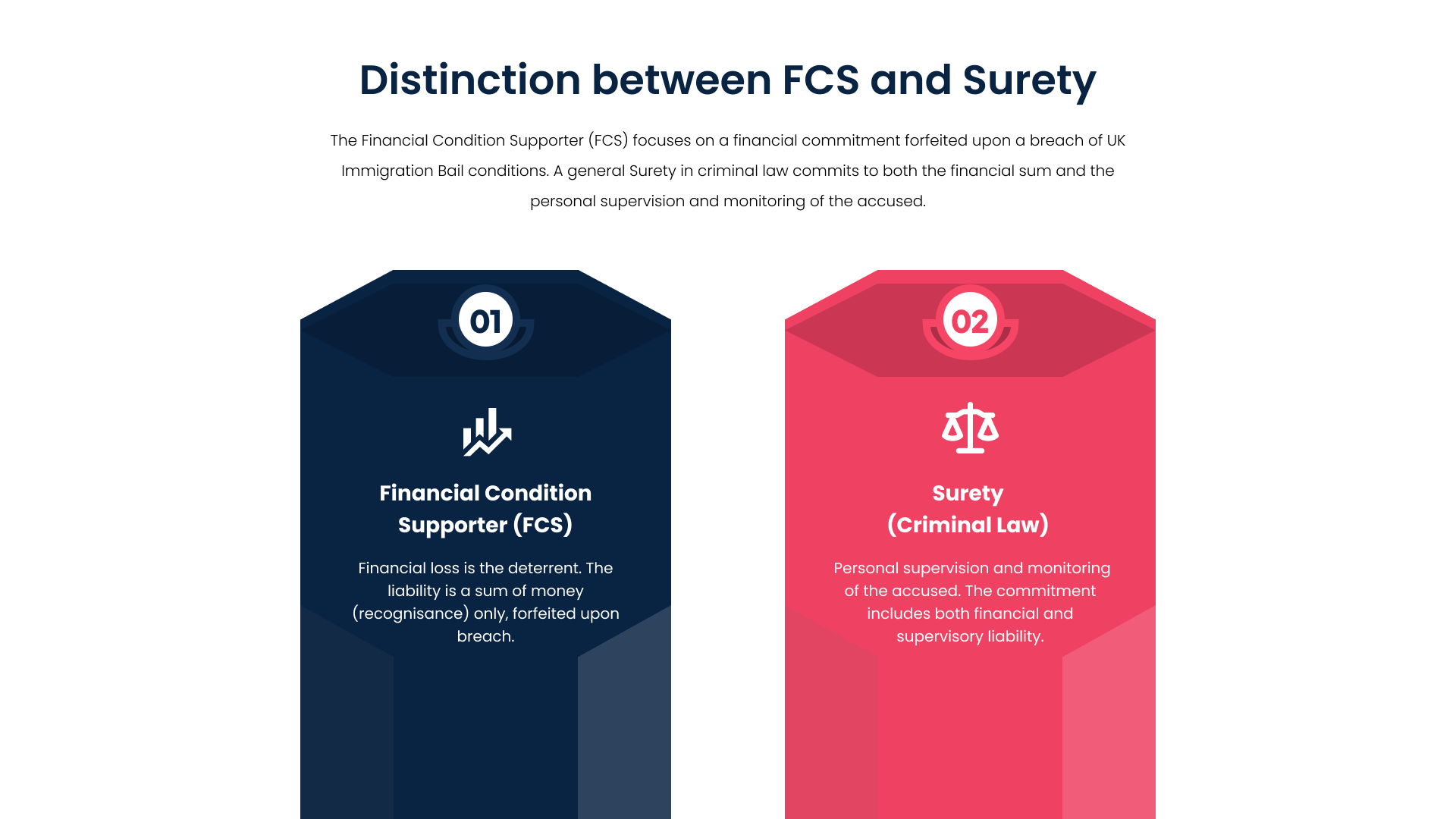
People frequently confuse the Financial Condition Supporter (FCS) with a Surety in criminal proceedings, but they operate differently under UK Immigration Law. Understanding this distinction is vital for anyone taking on this responsibility:
| Feature | Financial Condition Supporter (FCS) | Surety (General/Criminal Law Context) |
| Primary Liability | Commits a specific financial sum (recognisance) only upon breach. | Often commits both financial sum and personal supervision. |
| Focus | Financial loss utilised as a deterrent against non-compliance. | Personal supervision and monitoring of the accused’s behaviour. |
In the immigration context, the FCS is specifically concerned with the financial promise. Their financial status, not necessarily their ability to supervise, is the critical factor.
Who is Eligible to Act as an FCS in the UK?
The Tribunal or Home Office must approve the FCS’s suitability. Eligibility requirements are strict and demand careful consideration from every potential supporter:
- Age: Must be over the age of 18.
- Residence Status: Must be legally present in the UK.
- Financial Capability: Must demonstrate control over the full amount of the financial condition.
- Relationship: Must possess a genuine relationship with the applicant, proving commitment and trust.
- Understanding: Must fully comprehend and agree to the entire extent of their legal liability and the purpose of the recognisance.
The Legal Basis for Financial Conditions
The authority to impose financial conditions and require an FCS stems directly from UK primary legislation. Legal professionals utilise an in-depth knowledge of this framework to build compelling bail applications that demonstrate the applicant’s low risk to the public and the robustness of the conditions.
Proof of Financial Means: Documentation Checklist

The decision-maker assesses the FCS’s ability to pay the specified financial sum. They require definitive proof of means to ensure the commitment is serious and credible.
The documentation required is extensive and must be clearly presented:
- Bank Statements: Original or certified copies showing the funds have been held in a UK bank account for a significant period (often 90 days is recommended).
- Income Evidence: Evidence of regular income such as payslips, employment letters, or self-assessment tax returns (HMRC documents).
- Asset Documentation (If Applicable): Proof of ownership of substantial assets may be considered, although cash funds are generally preferred.
- Identity and Address Proof: Clear copies of Photo ID and recent utility bills or council tax statements.
The FCS must demonstrate that they have undisputed control over the money pledged; joint accounts or money held by third parties are often rejected.
Key Responsibilities and Obligations of an FCS
Acceptance of the FCS role creates a legally binding contract with the state. This responsibility extends beyond simply guaranteeing the money; it represents a commitment to the integrity of the bail process itself. It is essential that every FCS understands this obligation completely, as failure to do so carries serious consequences.
Understanding the Recognisance Amount
The financial amount required is not a deposit paid upfront. It is a sum promised, which is only forfeited if the bail conditions are broken. The money remains in the FCS’s control unless a breach occurs and the court orders forfeiture.
Factors determining the financial sum
An Immigration Judge or the Home Office determines the amount based on various factors related to the applicant:
| Factor | Description | Impact on Recognisance Amount |
| Risk of Absconding | The perceived likelihood that the applicant will fail to comply with removal directions or reporting. | Higher Risk = Higher Sum |
| Severity of Case | Considerations of public order or previous immigration breaches. | Increased Severity = Increased Sum |
| FCS’s Means | The financial capacity of the supporter to pay the sum. | Must be affordable yet deterrent. |
The sum must be high enough to act as a significant deterrent to non-compliance but reasonable for the supporter to commit.
What Happens if Conditions are Breached?
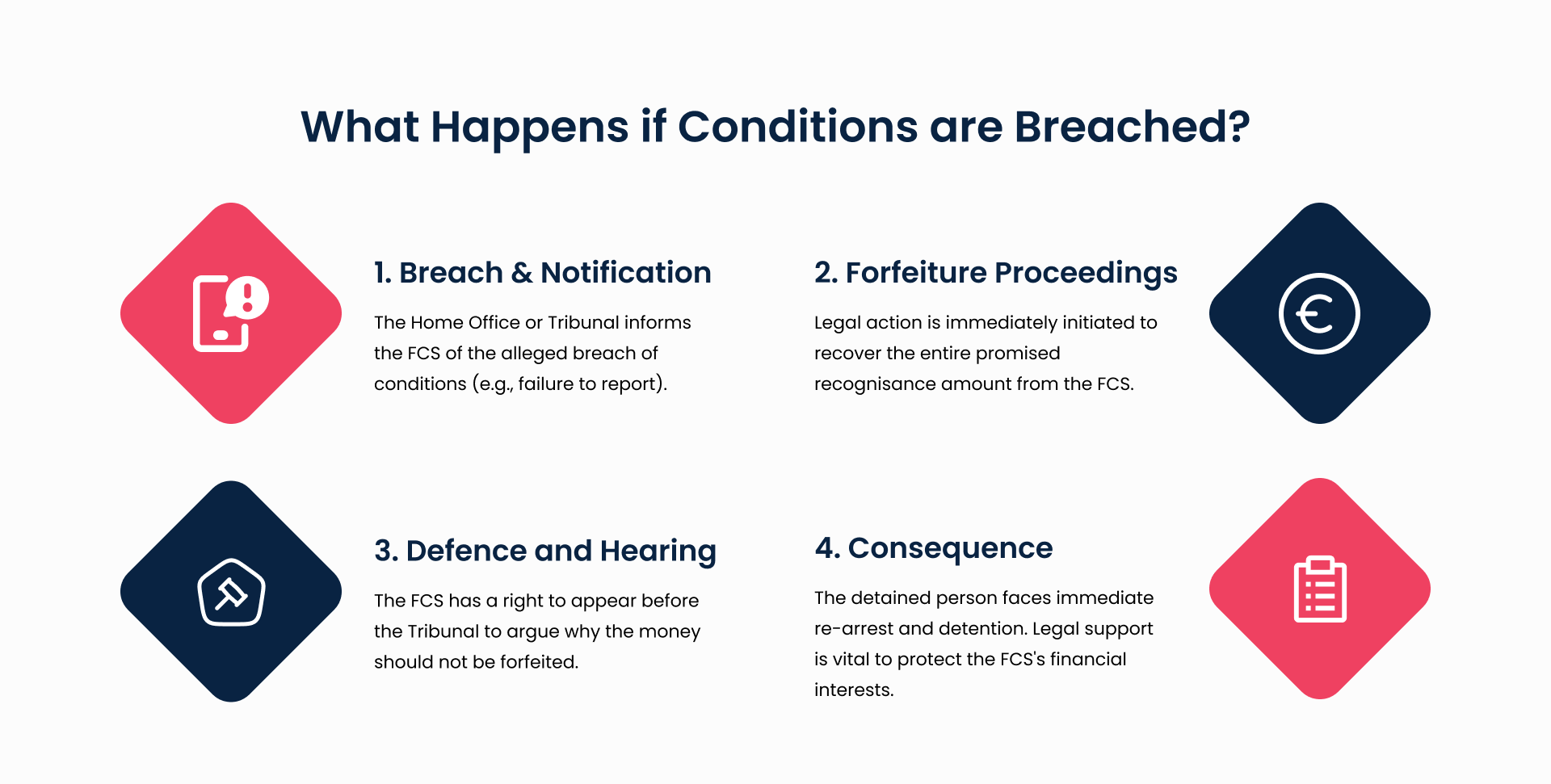
A breach of a bail condition (e.g., failing to report to the police or Home Office, or moving address without permission) triggers the forfeiture process.
- Notification: The Home Office or Tribunal informs the FCS of the alleged breach.
- Forfeiture Proceedings: Legal action is initiated to recover the entire recognisance amount from the FCS.
- Defence: The FCS receives notice and has a right to appear before the Tribunal to argue why the money should not be forfeited.
- Re-detention: The detained person faces immediate arrest and re-detention.
Specialist legal representation is crucial for the FCS during any forfeiture proceedings to protect their financial interests.
Ensuring Compliance with Bail Conditions

While the bail applicant retains primary responsibility for compliance, the FCS plays a vital monitoring and supportive role. The recognisance exists to guarantee compliance.
Attendance and Residence requirements
The applicant must attend all scheduled appointments, and the FCS should support this, understanding that failure to attend constitutes a breach.
- Attendance Conditions: These include regular reporting at a specific Reporting Centre in Glasgow or elsewhere in Scotland (e.g., weekly or fortnightly) and attending all scheduled Immigration Tribunal hearings.
- Residence Conditions: The applicant must live at a specified, approved address, and they must notify the Home Office and Tribunal immediately of any change.3
Other restrictions may involve Electronic Monitoring (tagging), or specific limitations on travel or work. The FCS is implicitly responsible for ensuring these are observed.
JRI: Your Solicitors for Immigration Bail Matters in Glasgow
JRI Solicitors provide peace of mind through a period of immense uncertainty. We offer authoritative legal guidance, focusing strictly on UK and Scottish immigration law. We act decisively to protect your freedom and secure your release. Our commitment is to achieve the best possible outcome for you and your family.
Specialist Assistance for Applicants and Supporters
We simplify the complex process for all parties involved, ensuring both the detained person and the FCS understand their position and the path forward.
Advising on suitability and legal obligations
We conduct a thorough initial assessment of the potential FCS, advising them on the legal jargon and the full extent of the recognisance liability. Our advice covers:
- Risk Assessment: We clearly explain the financial risk involved in the commitment.
- Condition Monitoring: We detail the expected monitoring role to ensure bail conditions are met.
- Suitability Criteria: We rigorously check that they meet all eligibility requirements before the application is submitted.
Preparing Documentation and Legal Submissions
Our team is skilled at assembling the necessary legal bundle. We draft persuasive written legal submissions that present the strongest case for bail, arguing why detention is no longer justified and why the FCS provides a reliable safeguard against non-compliance. We ensure all evidence is admissible and compelling.
Our Commitment to Clarity and Legal Accuracy
We commit to the highest standard of legal professionalism, guaranteeing accuracy in every submission we prepare. Our firm’s reputation rests on our precise application of law.
Expertise in Current UK/Scottish Immigration Precedents
Our solicitors possess in-depth knowledge of the latest UK immigration precedents and case law specific to Immigration Bail. We apply current rulings from superior courts to your case, providing a superior legal advantage. We understand the specific concerns and procedural requirements of the Glasgow immigration courts, giving you a local edge.
Ensuring All Bail Conditions are Accurately Conveyed and Met
When bail is granted, we immediately clarify the exact bail conditions imposed by the Judge or Home Office. This is non-negotiable for future compliance:
- We provide the FCS and applicant with a clear, written summary of all reporting and residence terms.
- We explain the mechanisms for notifying the Home Office of any necessary change.
- We safeguard the recognisance amount by ensuring full, precise adherence to every condition.
Facing detention or considering becoming an FCS? Contact JRI Solicitors in Glasgow today for decisive legal advice. We are ready to act immediately to protect your freedom and financial interests.

