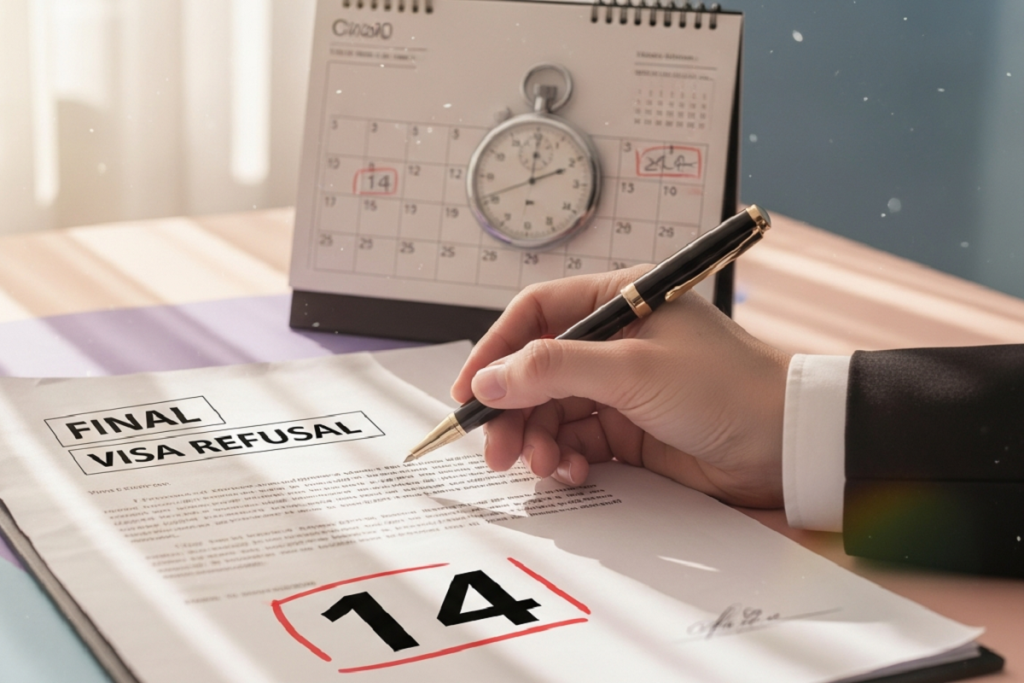
Responding to a visa refusal in Scotland requires addressing legal procedures and demonstrating valid reasons for disputing the Home Office’s determination.
Process Errors:
- Process errors occur when there are mistakes in the way a visa application is handled, such as not following set procedures or administrative oversights.
- Process errors can form a reason to dispute a visa refusal.
- If there were mistakes in how the application was handled, such as failure to consider all submitted proof or not following the proper legal steps, these can be reasons for a dispute.
- For instance, if the Home Office failed to consider all the presented material or did not adhere to the correct legal protocols, a dispute may be justified.
Legal Misinterpretations:
- Legal misinterpretations arise when the decision-maker incorrectly interprets or applies legal rules or immigration laws.
- Legal misinterpretations occur when the decision-maker misinterprets or misapplies the law.
- This can include incorrect application of immigration rules or failure to apply relevant legal principles. For example, if the decision-maker incorrectly interprets the requirements for a visa category, this can be challenged.
Unjustified Decisions and Basic Rights:
- An unjustified decision occurs when a visa refusal significantly and unfairly impacts an individual’s protected basic rights.
- Decisions that unfairly impact an individual’s basic rights can be disputed.
- This includes situations where the refusal of a visa would result in a major and unjustified impact on the individual’s right to family life or other protected rights under the European Convention on Human Rights.
- To show an unjustified decision, proof must be provided to show the severe impact on the individual’s rights.
New Information:
- New information refers to relevant material that was not available when the initial visa application was made.
- If added information becomes known that was not available at the time of the original application, this can be a reason to dispute.
- This information must be relevant and significant enough to potentially change the outcome of the decision.
Valid Dispute Requirements:
- A valid dispute must be based on one or more of the reasons mentioned above.
- It must be submitted within the specified time limits and follow the correct procedure.
- The dispute must clearly state the reasons it is being made and provide supporting proof.
Times:
- The periods for submitting a dispute are strict.
- A dispute must be submitted within 14 days of receiving the refusal decision if the individual is in the UK, or within 28 days if they are outside the UK.
- It is vital to adhere to these deadlines to ensure the dispute is considered.
Courts Involved:
- In Scotland, visa disputes are initially heard by the First-tier Tribunal (Immigration and Asylum Chamber).
- If the dispute is unsuccessful, further disputes can be made to the Upper Tribunal and, in some instances, to the Court of Session.
If my visa was refused due to incorrect information provided by the Home Office, can I dispute?
- Yes, if it can be shown that the refusal was based on a mistake of fact or law, a dispute may be submitted.
- This requires a detailed examination of the decision notice and the supporting proof.
What proof is required to show an unjustified decision?
- Proof must show the major impact on the individual’s basic rights, such as the right to family life.
- This can include personal statements, expert reports, and any other relevant documentation.
What are the chances of a successful dispute?
- The chances of success depend on the strength of the reasons for dispute and the quality of the proof provided.
- Legal advice from an experienced solicitor can significantly enhance the prospects of a successful dispute.
Where do I submit my visa dispute in Glasgow?
- Visa disputes in Glasgow are submitted to the First-tier Tribunal (Immigration and Asylum Chamber).
- The Scottish Ministers are responsible for forwarding the dispute form and relevant information to the Tribunal.
What is the difference between an administrative review and a dispute?
- An administrative review is a process where the Home Office reconsiders its decision based on the information available when the original decision was made.
- A dispute, on the other hand, is a judicial process where an independent tribunal reviews the decision and can consider latest information.
How JRI Can Help?
- At JRI, we focus on Scottish immigration law and have extensive experience in handling visa disputes in Glasgow.
- Our team can assist with the preparation of disputes, ensuring all relevant reasons and proof are thoroughly presented.
- We provide representation at tribunals and court hearings, using our local knowledge and legal expertise to advocate effectively on your behalf.